Currently Empty: $0.00
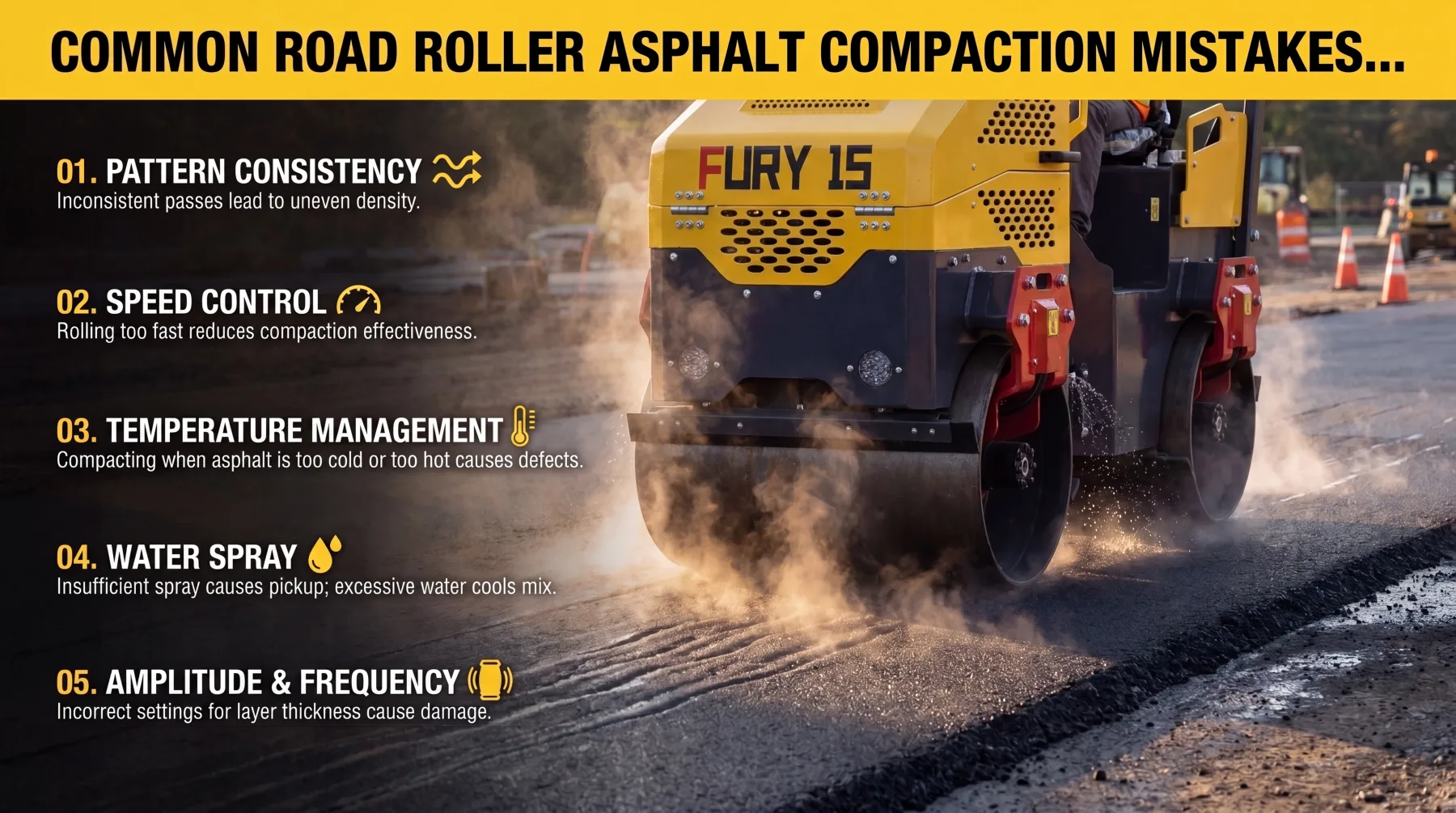
Common Road Roller Asphalt Compaction Mistakes and How to Avoid Them
Asphalt compaction is where a good paving job succeeds or falls apart. You can lay a perfect mat, but if the rolling is off, the pavement will lose density, crack early, and cost far more to repair than it ever should have. Small errors in pattern, speed, temperature, water, and joint work quietly undermine the finished surface, and many of them are easy to miss until the damage appears months later.The good news is that these mistakes are preventable once you know what to watch for. Getting compaction right protects your density targets, extends road life, and keeps your crew working efficiently pass after pass.This guide walks through the five most common road roller asphalt compaction mistakes and shows you exactly how to avoid each one. You will learn how to hold a consistent rolling pattern, dial in the correct speed and vibration, manage mat temperature, control water spray, and compact joints the right way.Improper Rolling Pattern
One of the most frequent mistakes operators make is failing to maintain a consistent, overlapping path across the mat. When passes drift or overlap inconsistently, you end up with weak spots and uneven density throughout the pavement surface. Some areas get compacted several times while others receive too little coverage, and that inconsistency shows up later as ruts, low-density zones, and premature surface failure. A pattern that looks close enough by eye is rarely close enough for the density your specification demands.To avoid this, always maintain a steady, uniform overlap of approximately 15 to 20 centimeters on each pass. That consistent overlap ensures the drum covers the full width of the mat without leaving gaps or double-compacting the same strip unnecessarily. Just as important, follow a systematic longitudinal pattern rather than rolling wherever seems convenient. Working in straight, planned lines down the length of the mat keeps your coverage predictable and your density uniform from edge to edge.Discipline is what makes a rolling pattern work. Plan your passes before you start, keep the drum tracking parallel to the direction of paving, and hold your overlap steady from the first pass to the last. Avoid sudden turns, stops, or direction changes on hot asphalt, since these leave marks and disrupt the mat. When you commit to a repeatable, overlapping longitudinal pattern, every square meter of the surface receives the same rolling effort, and that consistency is exactly what produces a strong, uniform pavement that holds up under traffic for years.Incorrect Speed and Frequency Selection
Speed and vibration frequency work together, and getting either one wrong can ruin an otherwise solid mat. Driving the roller too fast is one of the most common errors, because it prevents the drum from delivering enough impacts per meter to achieve full density. Push the pace and you leave density on the table. Set the vibration frequency too high for the conditions, and you risk the opposite problem: the asphalt begins to push, shove, or develop surface waves that no amount of finish rolling will smooth out.The fix starts with treating your machine settings as variables, not fixed defaults. Always calibrate your speed and vibration settings according to the asphalt mix design and layer thickness. A thin lift behaves very differently from a thick one, and a coarse mix responds differently than a fine one. Match your amplitude, frequency, and travel speed to what the material in front of you actually needs, and confirm those settings against the mix design rather than guessing.Above all, keep the machine moving at a pace that allows for adequate compaction without disrupting the mat. A steady, controlled speed gives the drum time to work the material to target density while avoiding the shoving and waving that come from rushing. Watch the mat closely as you roll: if you see the surface moving ahead of the drum or ripples forming behind it, slow down and reassess your frequency. Consistent, well-matched settings protect both the smoothness and the strength of the finished pavement, and they keep you from chasing defects after the mat has already cooled.Failing to Manage Mat Temperature

Temperature is the invisible clock that governs every compaction pass, and ignoring it is a costly mistake. Asphalt has a narrow window in which it compacts properly, and working outside that window undermines the entire effort. Compacting asphalt when it is too cold prevents the material from achieving its target density, because the mix has stiffened too much for the drum to move the aggregate into place. Once the mat has cooled past the point of workability, no additional rolling will recover the density you lost.
Working too hot creates a different set of problems. When you roll a mat that is still above the recommended range, you risk “checking,” a pattern of hairline surface cracking that weakens the pavement and mars its appearance. That means both ends of the temperature range carry real consequences, and your job is to work squarely within them. The following habits keep you on track:
- Monitor the mix temperature continuously with a reliable probe or infrared thermometer rather than relying on feel.
- Complete breakdown and intermediate rolling while the material is still within the manufacturer-recommended optimal temperature range.
- Adjust your rolling sequence to keep pace with the mat as it cools, especially in cold or windy conditions that pull heat out faster.
The key is to treat temperature as a driver of your rolling schedule, not an afterthought. Get your breakdown roller onto the mat promptly, keep your passes organized so you finish compaction before the material drops out of range, and stay aware of how ambient conditions are affecting cooling. When you roll within the recommended temperature window every time, you give the mix its best chance to reach full density and stay crack-free for the long haul.
Excessive or Inadequate Water Usage

Water seems like a minor detail, but on a vibratory roller it has a direct effect on both the mat and the finished surface. The water spray system keeps the drums wet so hot asphalt does not stick to them, and balancing that spray correctly matters more than many operators realize. Use too much water, and you cool the asphalt mix prematurely, robbing yourself of workable time and making it harder to reach target density before the mat stiffens. Overwatering can turn a comfortable temperature window into a rushed one.
Use too little water, and the problem flips. When the drums are not adequately wetted, the mix begins to stick to them, and that material pickup tears the surface as the drum rotates. The result is a rough, damaged mat that requires extra finish work or, in bad cases, repair. So the goal is a careful middle ground: apply only the minimum amount of water necessary to prevent material pickup, keeping the drums just wet enough to stay clean without flooding the mat.
Managing water well comes down to equipment and awareness. First, ensure the spray system is functioning correctly, with clear nozzles and even coverage across the full drum width, since a clogged nozzle can cause sticking in one spot even when your overall flow is fine. Second, adjust your spray frequency based on the ambient temperature and wind conditions. Hot, dry, windy days evaporate water quickly and may call for more frequent spraying, while cool, calm conditions need far less. By checking your system before each shift and tuning your spray to the weather, you protect the mat temperature and keep the surface clean and intact.
Neglecting Joint Compaction
Longitudinal joints are the weakest link in most asphalt pavements, and neglecting them is a mistake that leads directly to premature failure. A joint is where two mats meet, and if it is not compacted to proper density, water finds its way in. Starting the rolling process too far from a longitudinal joint, or failing to properly pinch the seam, often results in weak, permeable joints. Those low-density seams admit moisture, ravel under traffic, and crack open well before the surrounding pavement wears out, which turns a small oversight into an expensive, road-shortening problem.
The solution is to give joints deliberate, focused attention rather than treating them like ordinary mat. One proven approach is to roll the unconfined edge first, compacting the free edge before you tie into the adjacent lane. Another reliable technique is the “pinch” method, where you overlap the joint with the drum to squeeze both sides of the seam together. Both approaches share the same goal: driving the aggregate into tight contact so the two mats behave as one continuous surface.
What you are really after at every joint is proper aggregate interlock and density at these critical connection points. When the aggregate locks together and the seam reaches full density, the joint becomes nearly impermeable and resists the water intrusion that destroys roads from the inside out. Take the time to position your roller correctly, overlap the seam with intention, and confirm that the joint feels as tight and solid as the rest of the mat. Careful joint compaction is one of the highest-value habits you can build, because it protects the exact spot where pavements most often begin to fail.
Conclusion
Strong, long-lasting asphalt comes down to controlling the details that most compaction problems hide in. Hold a consistent 15 to 20 centimeter overlap in a systematic longitudinal pattern, calibrate your speed and vibration to the mix design and layer thickness, and complete your rolling within the manufacturer-recommended temperature range. Balance your water spray to prevent both premature cooling and material pickup, and give every longitudinal joint the pinch-method attention it needs for full aggregate interlock and density. Each of these habits reinforces the others, so a disciplined, well-planned rolling process protects your density, your smoothness, and the service life of the pavement. Review your rolling procedures against these five points before your next paving job, train your operators to follow them consistently, and you will avoid the mistakes that quietly turn good asphalt into early repairs.