Currently Empty: $0.00
Why the Water Spray Matters More on Hot Days
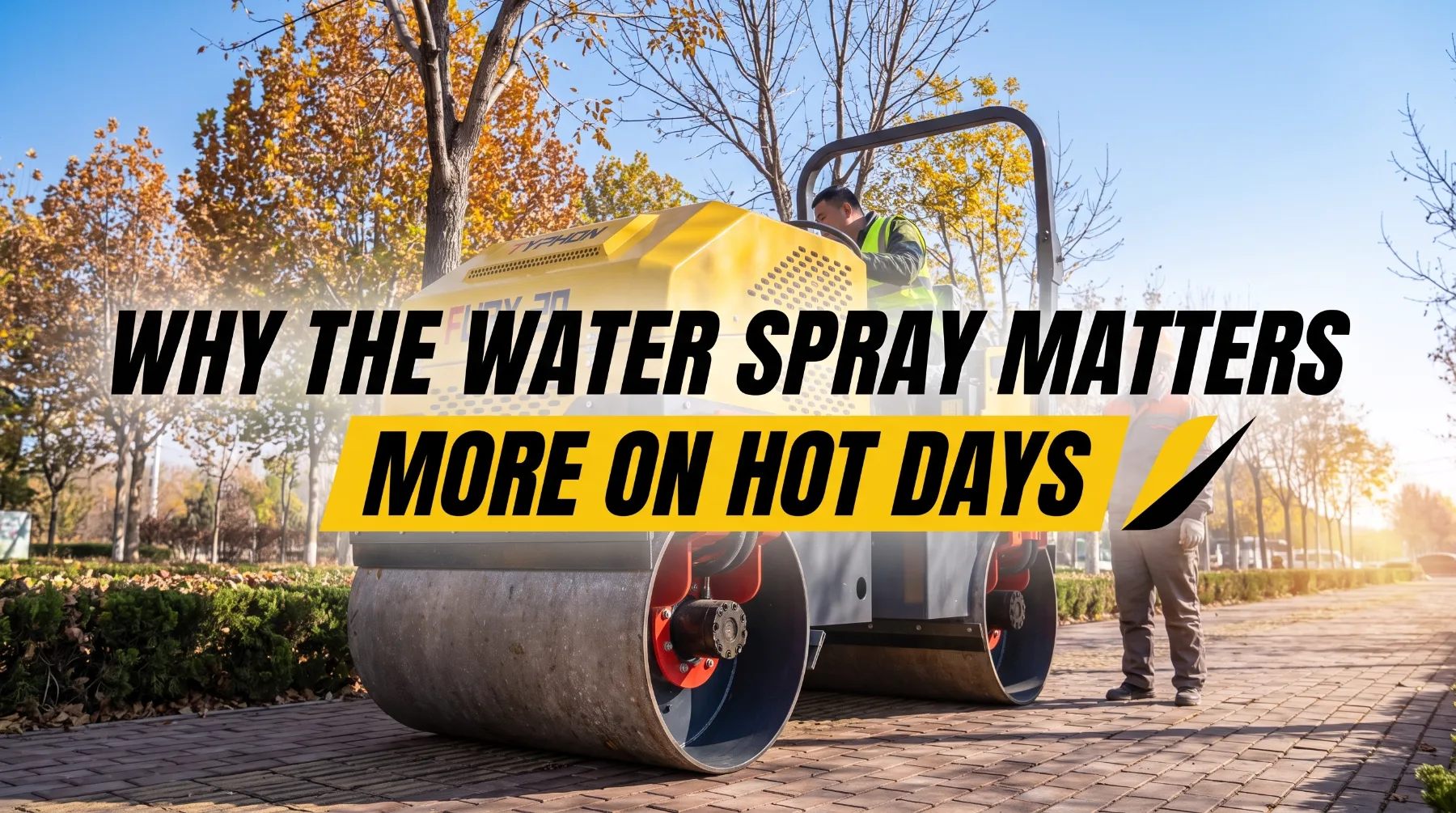 Heat can change the way a road roller performs long before the operator notices a problem. High pavement temperatures affect asphalt behavior, drum contact, and the conditions under which compaction takes place. In these demanding conditions, the water spray system becomes more than a simple cooling or cleaning feature. It helps keep the drum surface properly conditioned and supports consistent contact with the asphalt throughout the compaction process. The importance of the spray system becomes especially clear during hot paving operations, when asphalt can become more prone to sticking to a dry drum. Without a reliable and even water application, material can build up on the drum surface, affecting the finish and interrupting the compaction process. Understanding how heat, asphalt temperature, drum conditions, and water application interact helps explain why the spray system can have such a significant effect on final surface quality.
What Heat Does to Asphalt Before the Roller Arrives
Fresh asphalt leaves the plant at high temperature by design. The bituminous binder must stay fluid enough to coat every aggregate particle evenly, and that fluidity depends entirely on heat. From the moment the mix lands on the base, it begins losing temperature, and its workability window narrows with every degree it sheds. Warm weather extends that window, which sounds like a benefit. It is, until the drum enters the picture. Asphalt that retains its heat stays pliable longer, but it also stays chemically adhesive longer. The binder remains in a state where it actively seeks to bond with surfaces it contacts. On a cool day, the mat stiffens quickly and releases cleanly. On a hot day, it stays in prime grabbing condition through multiple passes. What the operator faces is asphalt that is warm enough to compact smoothly but sticky enough to cling to any surface that touches it without protection.
How Drum Temperature Compounds the Risk
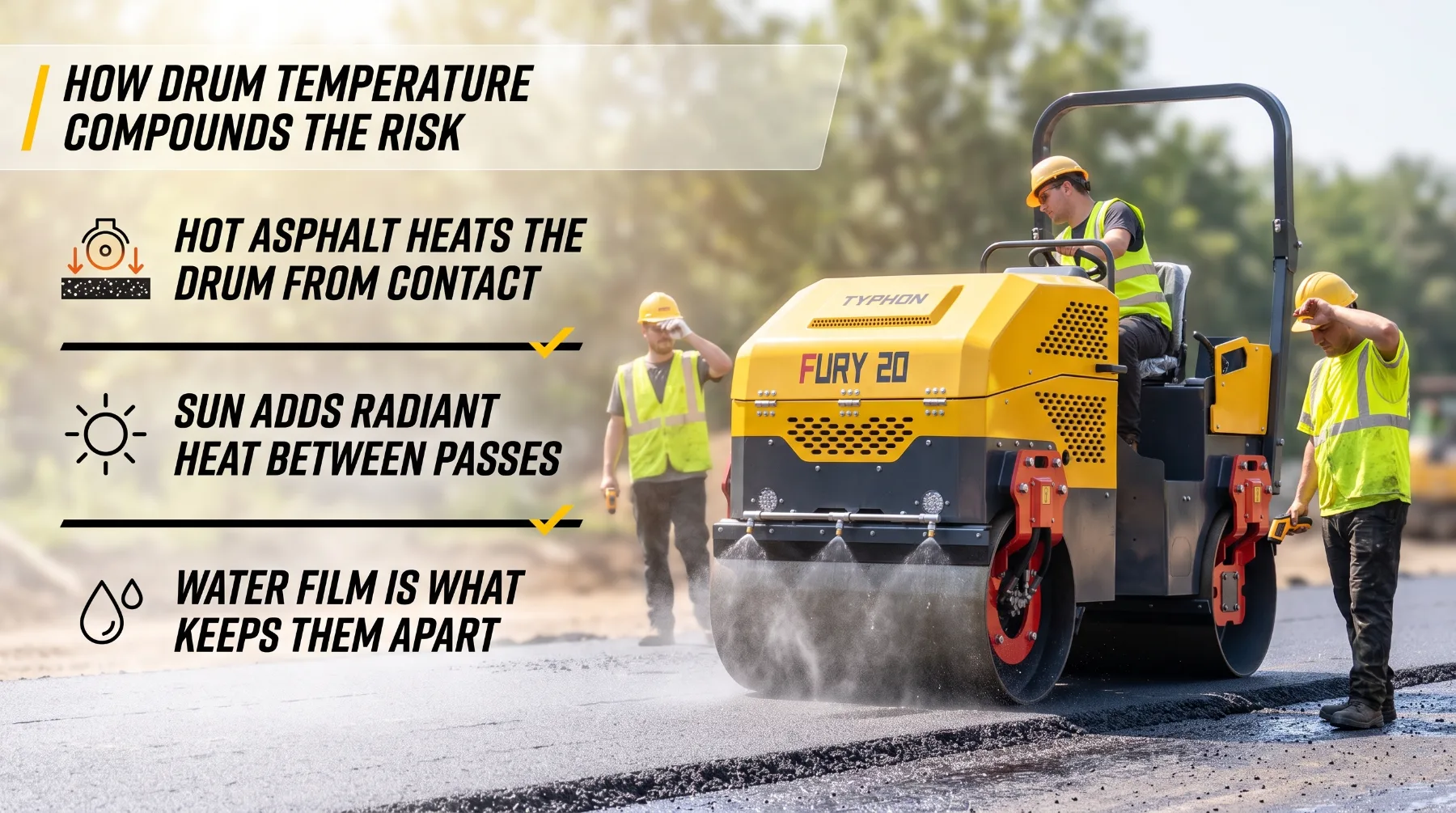 The drum on a road roller heats up from two directions simultaneously. Repeated contact with hot asphalt transfers heat directly into the steel, while radiant heat from a summer sun warms the drum surface between passes. Neither source alone is sufficient to cause adhesion. Together, they push drum temperature high enough that any asphalt touching it finds an equally warm surface ready to accept a bond. This is where the water spray system's role shifts from routine to essential. A cool drum and a cool mat resist each other naturally. A warm drum and warm asphalt attract each other, and only the water film interrupting that contact prevents material from peeling away from the road surface.
The Mechanics of Drum Adhesion and Surface Damage
When asphalt bonds to a dry drum, it does not remain stationary. The drum rotates, carrying that stuck material forward and then downward, where it presses back into the mat. On the next rotation, the same spot of dried asphalt grabs fresh material, and the buildup compounds. Within a few passes, a small patch of stuck material becomes a raised area that drags across the surface, leaving grooves and impressions along the entire lane. The damage this causes goes beyond appearance. Compaction relies on uniform pressure distributed evenly across the drum width. Any buildup on the drum surface creates an uneven contact area, producing zones of over-compaction beside zones the drum barely touches. The structural inconsistency this creates is invisible from the surface but measurable in core samples and durability over time.
Why Water Is the Specific Remedy
When considering the difference between pneumatic and steel drum rollers, the water spray system on a steel drum serves a specific purpose. The water spray does not cool the drum in any meaningful thermal sense. A thin mist of water cannot substantially lower the temperature of a large steel drum rolling continuously across hot asphalt. What it does instead is create a non-bonding interface layer. Bituminous binder cannot adhere to a wet steel surface with the same force it applies to a dry one. The water interrupts the molecular contact that allows the bond to initiate. No bond forms, no material lifts, and the drum surface stays clean through every rotation. The mechanism is physical rather than chemical, which is why flow rate and coverage evenness matter more than water temperature or any additive. The film simply has to be present and continuous across the full drum width at all times.
Spray System Weaknesses That Only Show Under Heat
A marginal spray system often goes undetected during mild-weather paving. Cool air and quickly stiffening asphalt provide natural protection that compensates for gaps in drum coverage. When hot weather eliminates that buffer, every weakness in the spray system becomes immediately visible in the finished mat.
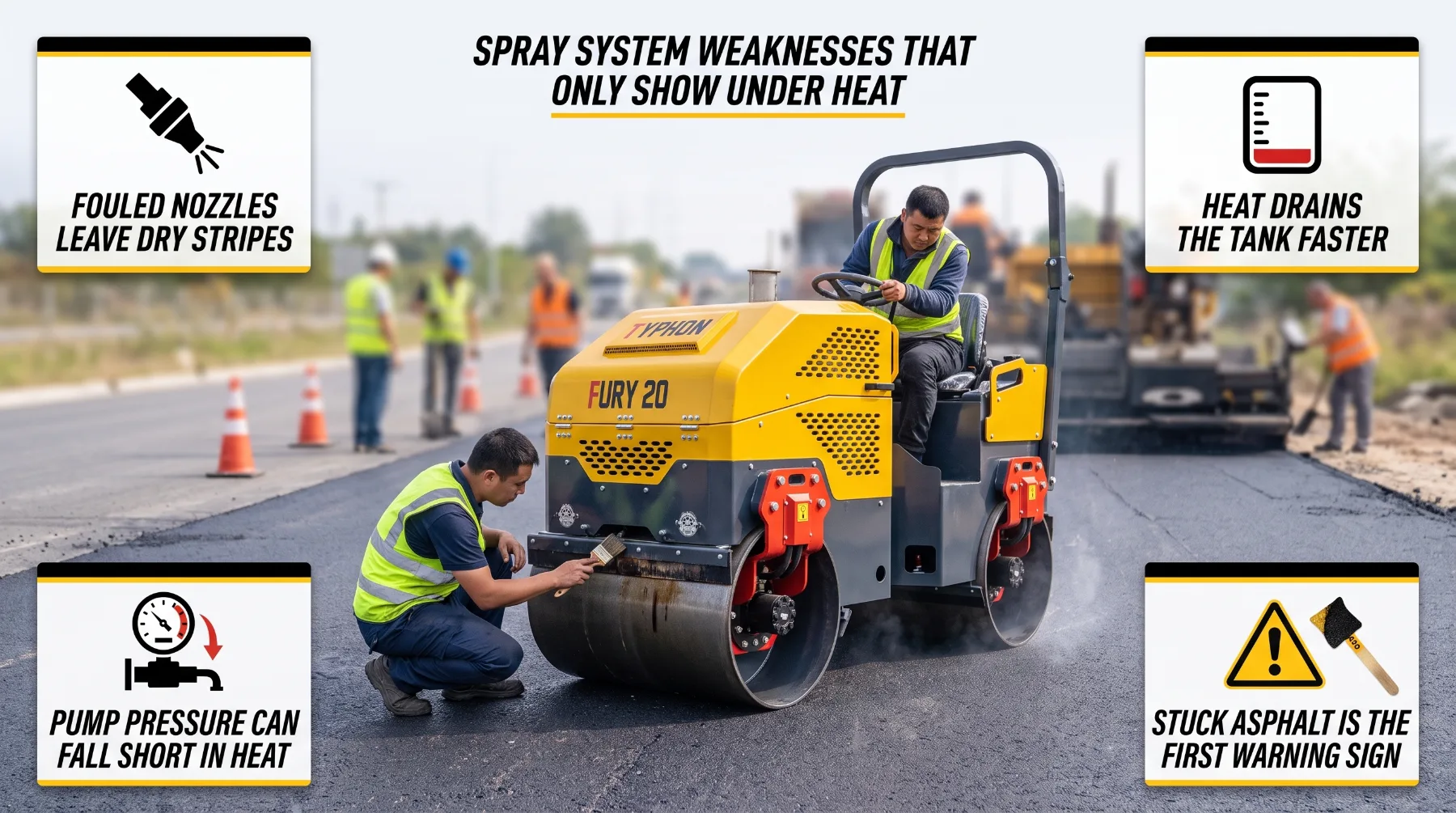 Nozzle fouling is the most common failure point. A partially clogged nozzle produces an uneven fan that leaves a dry stripe running the length of the drum. That stripe is all the adhesion needs to establish a foothold. Tank capacity matters differently in heat because evaporation and higher required flow rates drain the system faster than operators accustomed to cooler conditions expect. Pump pressure that barely keeps pace with demand on a moderate day may fall short entirely when heat requires sustained high output. None of these failures announce themselves before damage occurs. The first sign is usually material lifting from the mat, by which point the drum already carries a layer of stuck asphalt that will mark every pass until it is cleared.
Managing the System Through the Hottest Hours
Experienced operators do not set the spray and forget it. They treat hot-day paving as a dynamic condition that requires active monitoring and adjustment from the first pass to the last.
- Inspect the system before paving begins. Run the spray through its full range before the first truck arrives. Confirm every nozzle produces an even, unbroken fan. A nozzle that appears fine at low temperature can behave differently under operating heat, so a live check is more reliable than a visual inspection alone.
- Increase flow rate as temperature rises. Midday heat evaporates drum moisture far faster than morning conditions. Many systems allow flow adjustment. Use it. The goal is a visibly wet drum surface, not just occasional misting.
- Track tank level against time, not just visual checks. In hot conditions, calculate how long your tank lasts at the required flow rate and schedule refills before the level gets low. Running dry for even a single pass in peak heat is enough to start adhesion.
- Watch for early signs on the drum surface, not the mat. By the time the finished surface shows marks, the drum has already accumulated buildup. Train your attention on the drum itself between passes. A dull patch on an otherwise wet drum surface signals the start of a problem.
- Clear buildup at the first sign, not after it worsens. Stopping to clean a small amount of stuck asphalt takes minutes. Continuing over it multiplies the damage geometrically. Early intervention always costs less than extended repair.
- Evaluate additives based on your specific mix. Some crews use manufacturer-approved release agents in extremely high-temperature conditions. Verify compatibility with your mix design and regional specifications before use, as the wrong additive can affect surface texture or compliance.
What Clean Compaction Produces Over Time
The long-term performance of a paved surface is determined during the hours after the mat is laid. Compaction drives out air voids and brings aggregate particles into close, stable contact. The density achieved in those first passes sets the road's resistance to water intrusion, freeze-thaw cycling, and load-induced deformation across years of traffic. A drum that stays clean throughout the compaction window delivers consistent pressure zone by zone. Density builds uniformly, and the finished layer performs as engineered. A drum that picks up material, even briefly, introduces variation that no subsequent compaction can fully correct. The affected area carries a slightly different density profile than the surrounding mat, and that difference becomes a failure point as traffic and weather work the surface over time.
Conclusion
The water spray system on a road roller is a precision tool, not simply a convenience feature. It performs a specific physical function by preventing adhesion between the warm steel drum and tacky asphalt, something no other system on the machine can fully replicate. When conditions are mild, its importance may be easy to overlook, but when temperatures remain high and asphalt becomes more adhesive, the quality and consistency of the finished surface can depend heavily on whether the spray system delivers continuous, even coverage throughout every pass. Before selecting a roller for warm-climate or summer paving work, evaluate the spray system with the same attention given to drum width, operating weight, and compaction force. Confirm that tank capacity is sufficient for the longest expected runs, check nozzle coverage during actual operation, and verify that the pump and spray system can maintain consistent performance at maximum flow. A roller with reliable water distribution, adequate tank capacity, and properly functioning nozzles will help prevent asphalt buildup, reduce interruptions, and protect surface quality when paving conditions are at their most demanding.
Frequently Asked Questions
Why do spray systems that work fine in spring struggle in summer? Mild-weather paving benefits from rapid asphalt cooling, which reduces adhesion risk independently of drum moisture. As ambient temperature rises, that natural protection disappears, and the spray system must compensate entirely on its own. Systems that were never fully adequate simply become impossible to ignore once the temperature buffer is gone. How does uneven spray coverage affect compaction, not just surface appearance? Dry patches on the drum allow localized adhesion that lifts material from the mat, leaving a lower-density zone behind. Compaction equipment cannot re-compact a void left by lifted material in the same pass, so the affected area retains irregular density. Over time, that zone behaves differently under load, accelerating localized cracking or rutting. What should I check on a spray system before buying a roller for hot-climate work? Prioritize tank capacity relative to your typical paving run length, nozzle count and placement relative to drum width, pump pressure at maximum flow, and ease of cleaning and nozzle replacement. A system that covers the full drum evenly at high flow rates and allows quick field maintenance will serve hot-weather paving far better than one that looks adequate in moderate conditions.