Currently Empty: $0.00
Why Does Boom Swing Matter on a Mini Excavator
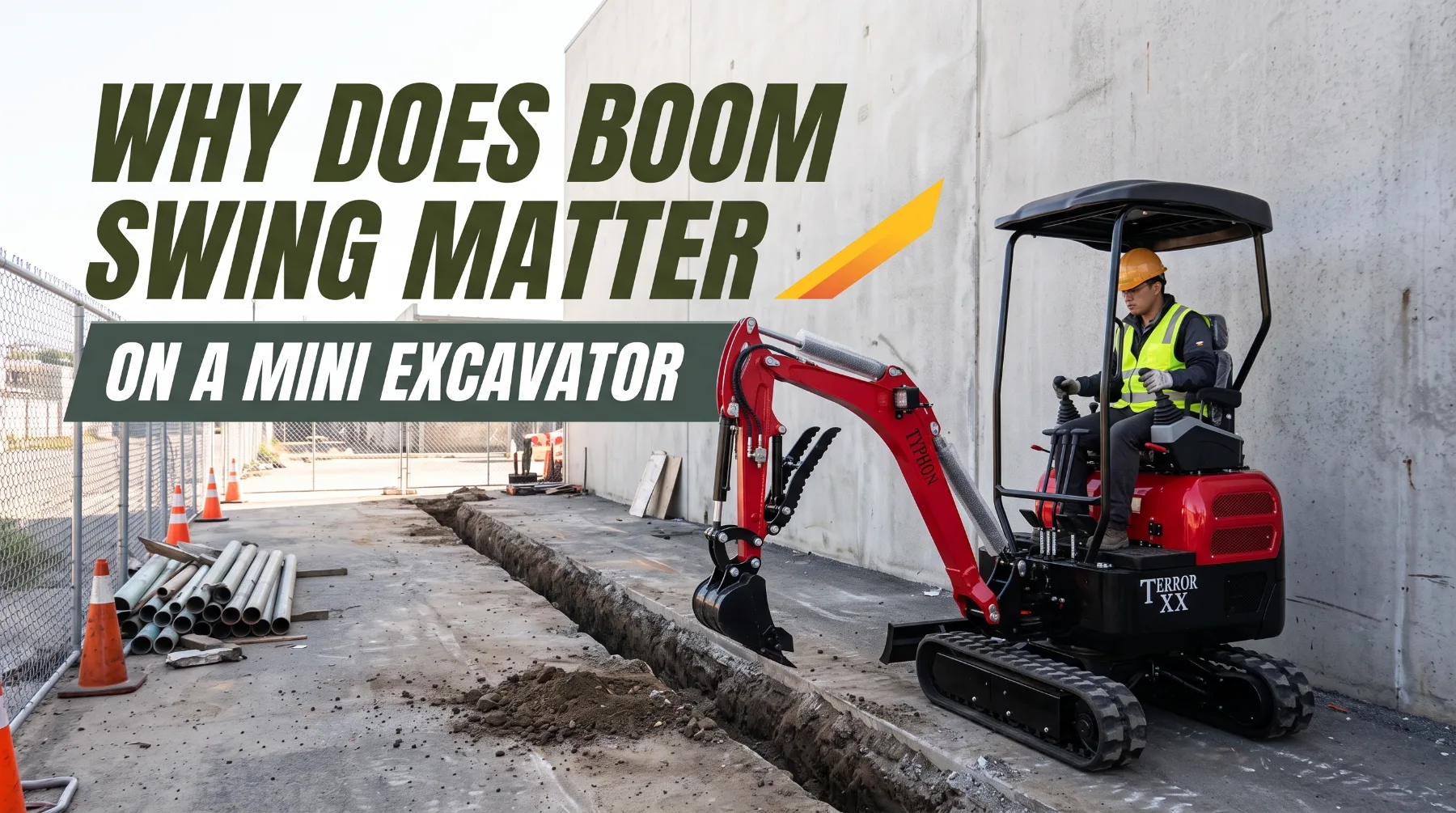
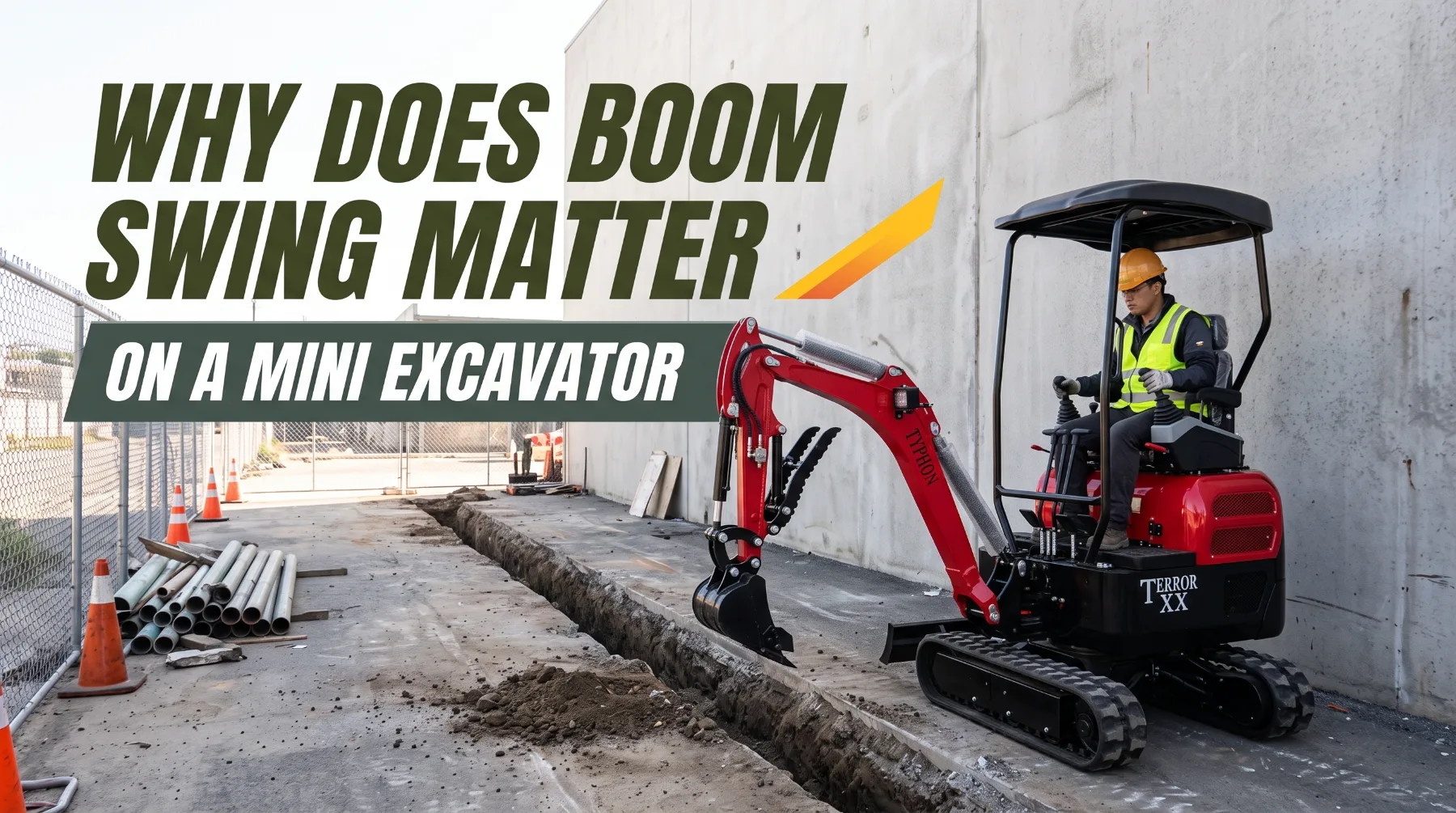 An operator sets up beside a house to dig a footing along the foundation, but the trench has to run exactly parallel to the wall. If the whole machine faces the cut head-on, the tracks end up crowding a flower bed on one side and a fence on the other, with no clean way to line up the bucket. Then a small adjustment solves everything: the boom pivots sideways, angling the arm to follow the wall while the tracks stay square and out of the way. That single move, offsetting the digging arm without turning the machine, is a boom swing at work. It rarely gets top billing when people talk about excavators, yet on jobs hemmed in by fixed structures, it often decides whether the work goes smoothly or turns into a battle of constant repositioning. Boom swing sounds like a minor detail, a boom that leans left or right. But that sideways motion changes what a small machine can do in places where every inch is claimed. This post breaks down what boom swing actually is and how it works, why it earns its value on confined jobsites, how it differs from full house rotation, how it makes offset trenching possible, what habits help operators use it well, and how to judge boom swing specs when picking a machine.
What Boom Swing Is and How It Works
Boom swing, also known as offset swing, is the ability of a mini excavator's boom to pivot left or right at its base, angling the digging arm away from the machine’s centerline. On most compact excavators, the boom mounts to a swing bracket or king post at the front of the upper structure, and a hydraulic cylinder pushes that bracket to one side or the other. As the cylinder extends or retracts, the entire boom, arm, and bucket assembly shifts sideways while the cab, engine, and tracks stay exactly where they sit. The result is a digging arm that can reach off to the side of the machine rather than only straight ahead. The range of that motion is usually described in degrees to each side, and it is often uneven, with more travel available in one direction than the other. A machine might swing 45 degrees to the left and 55 degrees to the right, for example. That asymmetry is deliberate, giving the operator extra reach on the side most useful for working alongside structures. What makes the feature so handy is that it operates independently of everything else. The tracks can point one way, the cab another, and the boom can still angle off to follow a wall or clear an obstacle. This independence is the whole point, since it lets the operator place the bucket precisely where a fixed boom never could. Key takeaway: Boom swing lets the boom pivot left or right at its base to offset the digging arm from the machine’s centerline, working independently of the tracks and cab so the bucket can reach off to the side.
Why Boom Swing Matters on Confined Jobsites
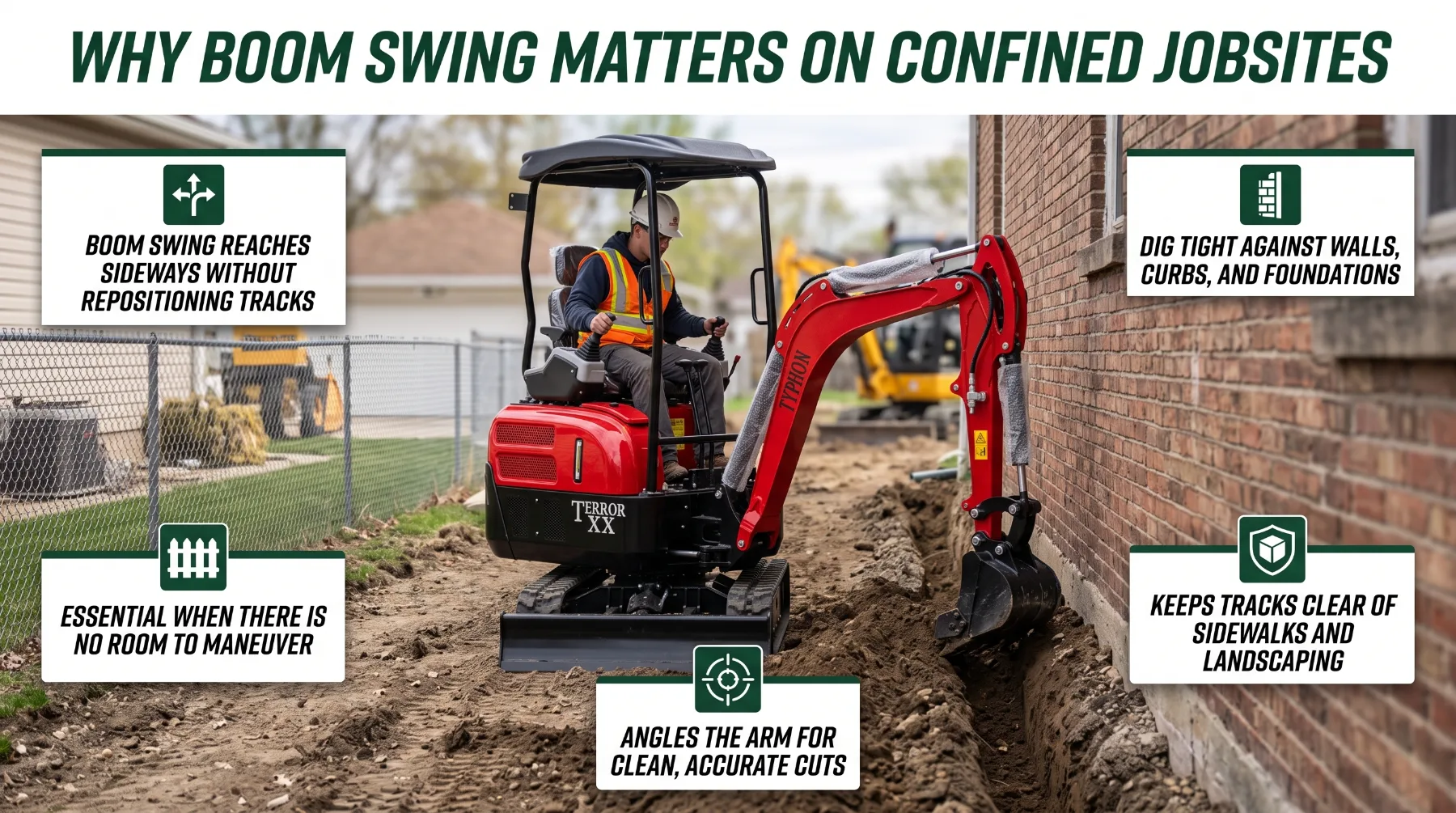 The value of boom swings rises steeply as a jobsite shrinks. On open ground, an operator can simply drive the machine into whatever position lines up the cut, so angling the boom feels optional. Inside a fenced yard, a narrow alley, or a lot boxed in by buildings, that freedom vanishes. There may be nowhere to reposition the tracks, and every extra maneuver risks scraping a wall, a fence, or a parked vehicle. Boom swing hands the operator a way to reach off to the side without moving the undercarriage at all, which is frequently the only path to getting the job done in cramped conditions. Think about the practical shape of confined work. A drainage line has to hug the edge of a building, a utility trench must skirt a curb, or a footing needs to run tight against an existing structure. Facing the machine straight at any of these forces awkward compromises, because the tracks want to sit where the trench belongs. With boom swing, the operator parks the machine clear of the cut, angles the arm over to the work line, and digs cleanly alongside the obstacle. Keeping the tracks planted also protects the surroundings, which matters enormously on residential and urban sites where finished landscaping, sidewalks, and walls press in close. Here, the ability to shift the arm rather than the whole machine is not a bonus feature. It is what makes the work possible without damage. Key takeaway: On confined sites, boom swing lets the operator reach off to the side and dig alongside obstacles without moving the tracks, which protects the surroundings and keeps cramped jobs workable.
How Boom Swing Compares to House Rotation
It is easy to lump boom swings together with house rotation, since both involve the machine turning some part of itself, but they solve very different problems. House rotation spins the entire upper structure, cab, boom, engine, and all, around on top of the undercarriage, usually a full 360 degrees. That motion is what carries a loaded bucket from the trench over to a spoil pile or a waiting truck, then back again, cycle after cycle. It handles the broad task of moving material and swinging the whole work zone from one direction to another. Boom swing works on a much smaller and more precise scale. Rather than turning the upper body, it nudges only the boom sideways, leaving the cab facing forward and the tracks untouched. Where house rotation repositions the entire digging effort, boom swing fine-tunes exactly where the bucket lands relative to a fixed feature. The two are complementary, not interchangeable. An operator uses rotation to dump spoil off to the side and boom swing to align the cut against a wall, and the best work in tight spaces often flows from blending the two: a measured rotation to clear the pile, then a touch of boom swing to settle the bucket back on the trench line. Understanding which motion suits which moment keeps the machine efficient and the tracks planted. Key takeaway: House rotation spins the whole upper structure to move, spoil and reposition the work, while boom swing shifts only the boom sideways for precise placement, and the two motions serve separate, complementary purposes.
How to Evaluate Boom Swing Specs When Choosing a Machine
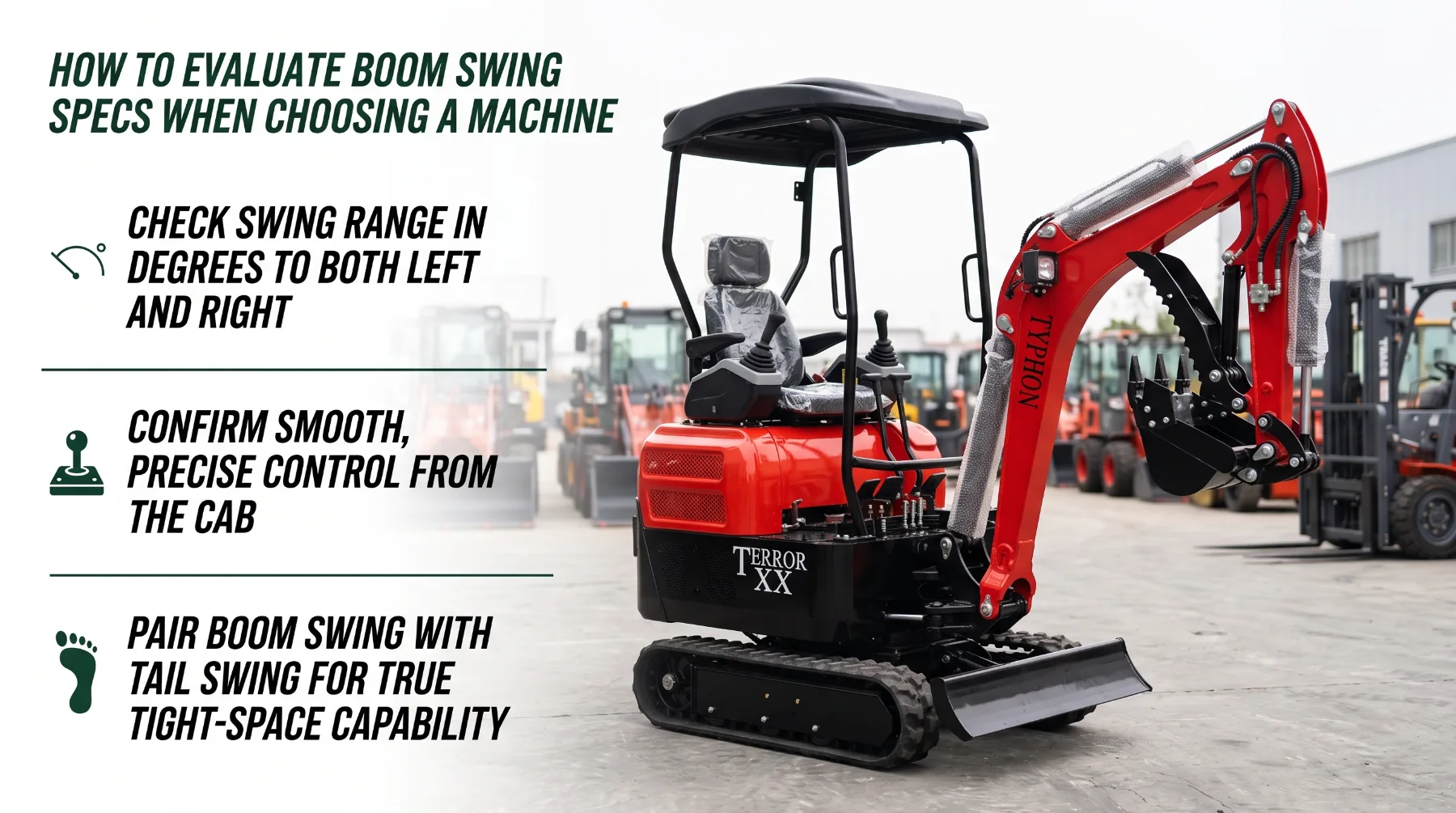 When your work routinely puts you alongside walls, fences, and foundations, boom swing specs deserve a careful read rather than a quick glance. Start with the swing range, usually listed as degrees of travel to the left and right. A generous range gives you more room to angle the arm and follow a structure, and because the two sides are often uneven, check both figures so you know which direction offers the most offset. Match those numbers against the kind of work you actually do, since a machine that swings well to the side you most often dig on will serve you better than one with an impressive figure in the wrong direction. From there, look at how the boom swing fits with the rest of the machine and your real conditions. Consider how the offset interacts with the machine’s stability, weight, and reach, since a wide swing range means little if the machine feels unsettled when the arm stretches to the side under load. Confirm the swing is smoothly controllable from the cab, because a jerky or imprecise offset is one you will struggle to place accurately against a wall. Think about how boom swing pairs with features like tail swing radius and overall footprint, since together they determine how well the machine truly performs in tight quarters. Wherever you can, run a candidate machine on ground like your own, angle the boom to trench alongside a wall, and feel how naturally it offsets and how steadily it holds. That hands-on test reveals confined-space capability that no printed figure fully captures. Key takeaway: Evaluate the left and right swing range against the side you dig on most, check how the offset affects stability under load, confirm smooth cab control, and test the swing alongside a wall on ground like your own.
Conclusion
Boom swing is one of those quiet capabilities that shapes a mini excavator’s usefulness far more than its modest description suggests. By letting the boom pivot sideways and offset the digging arm from the machine’s centerline, it allows an operator to dig straight along walls, skirt fences and curbs, and work around fixed obstacles, all without moving the tracks. That independence is what makes confined trenching possible in the tight residential and urban spaces where repositioning simply is not an option. Paired thoughtfully with house rotation, boom swing turns a compact machine into a precise tool that reaches exactly where the job demands, keeping the undercarriage planted and the surroundings safe. The machines that excel in cramped work are rarely the ones with the deepest dig or the most power. They are the ones that can place the bucket cleanly where there is no room to maneuver.
Frequently Asked Questions
\1
House rotation turns the entire upper structure, including the cab, boom, and engine, while boom swing pivots only the boom sideways from its base. House rotation moves the machine’s working area around the site, while boom swing positions the bucket beside walls, foundations, and other fixed obstacles. Operators often use both together for efficient tight-space work.
\1
Boom swing lets the operator angle the boom sideways while keeping the tracks straight and stable. This allows the bucket to follow a wall or foundation closely for trenches, drainage, and utility work. It also helps reach around posts, corners, and other obstacles without repeatedly repositioning the machine.
\1
The ideal range depends on the work, but many mini excavators provide about 45–55 degrees of swing to each side. Check the left and right ranges separately because they may differ. More offset can improve access beside structures, but it can also affect stability, so match the swing range to your typical digging conditions.