Currently Empty: $0.00
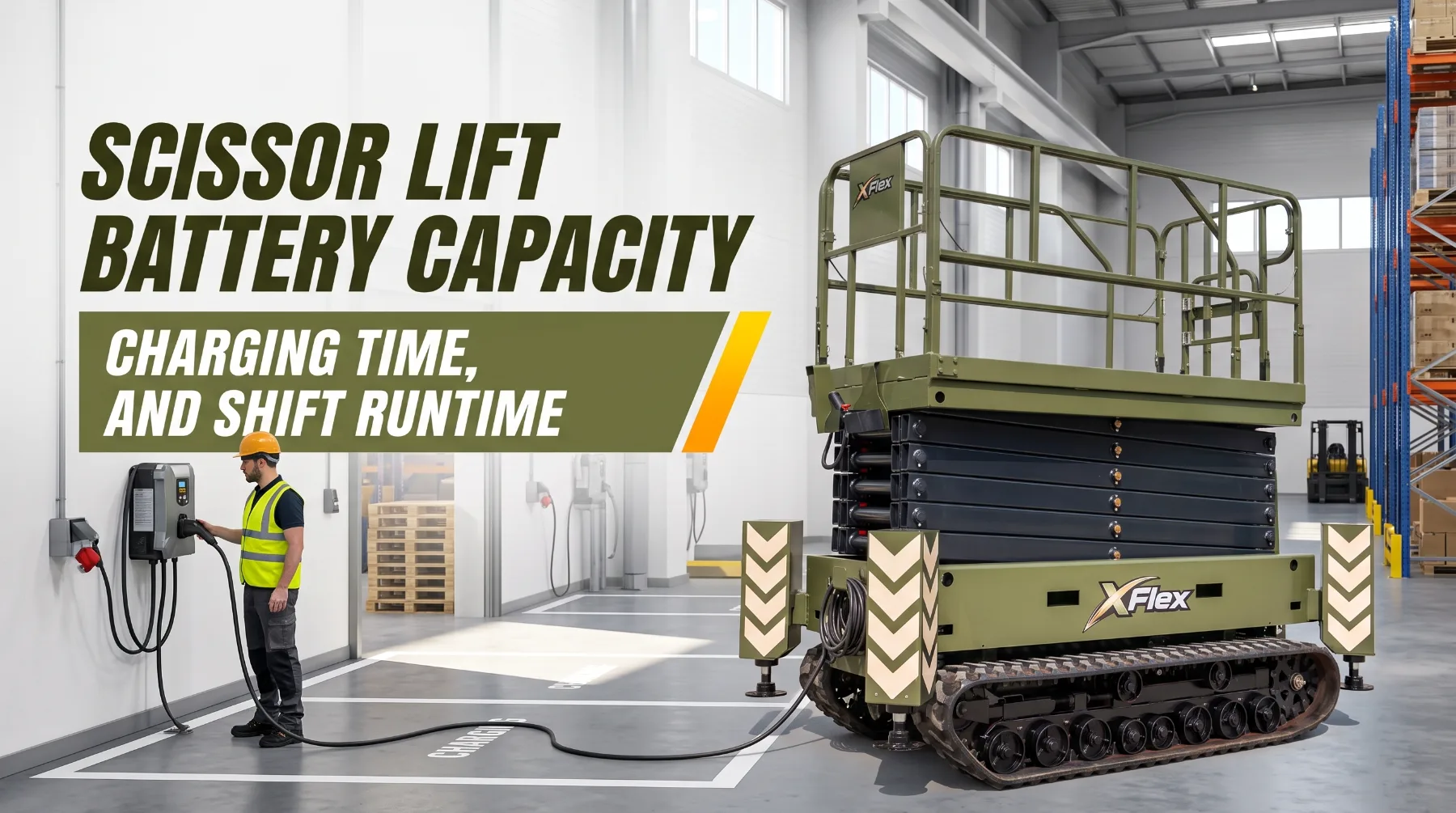
Scissor Lift Battery Capacity, Charging Time, and Shift Runtime
Before dawn, an electric scissor lift rolls onto a commercial construction site ready for a full day of installing lights and overhead fixtures. The crew expects it to lift, drive, reposition, and rise again through repeated work cycles without losing power halfway through the shift. By late morning, however, the platform begins moving slower, the drive feels sluggish, and the battery indicator drops toward empty while hours of work remain. Nothing has necessarily failed. The machine simply used more stored energy than the crew expected because the day’s workload demanded more from the battery than a quick look at its rating revealed.
Three factors largely shape battery performance on an electric scissor lift: how much energy the battery stores, how quickly that energy can be restored, and how rapidly different tasks consume it. Lifting the platform, driving between work areas, carrying loads, and frequent repositioning can all draw power at different rates. Understanding that relationship gives operators and fleet managers a better idea of how long the lift can remain productive before charging becomes necessary.
Real jobsite conditions make battery planning even more important. Shift length, travel distance, lift frequency, load levels, temperature, and charging opportunities can all affect available runtime. A practical plan should account for both energy use during the workday and the time required to recharge between shifts. Proper battery care then helps preserve capacity over repeated cycles, keeping the lift ready for the next task instead of turning an avoidable power shortage into downtime.
Measuring Battery Capacity
Battery capacity tells you how much electrical energy a scissor lift can store, and it is the starting point for every runtime decision. Capacity is usually described through two numbers: voltage, which reflects the electrical pressure the system runs at, and amp-hours, which measure how much current the battery can deliver over time. Together they define the total energy reserve available to power the machine, and a higher combined figure generally means more work between charges.
That stored energy has to cover three separate jobs. It powers the drive system that moves the lift across the site, the lift function that raises and lowers the platform, and the control and safety systems that run continuously while the machine is on. Each of these draws from the same reserve, so capacity is not just about how high or how far the lift can go once, but about how many complete cycles it can sustain through a shift. When comparing machines, read voltage and amp-hour ratings together rather than fixating on one, since both shape the real energy the lift carries into the workday.
Key takeaway: Battery capacity, defined by voltage and amp-hour ratings, sets the total energy reserve that powers a scissor lift’s drive, lift, and control functions throughout a shift.
Estimating Charging Time
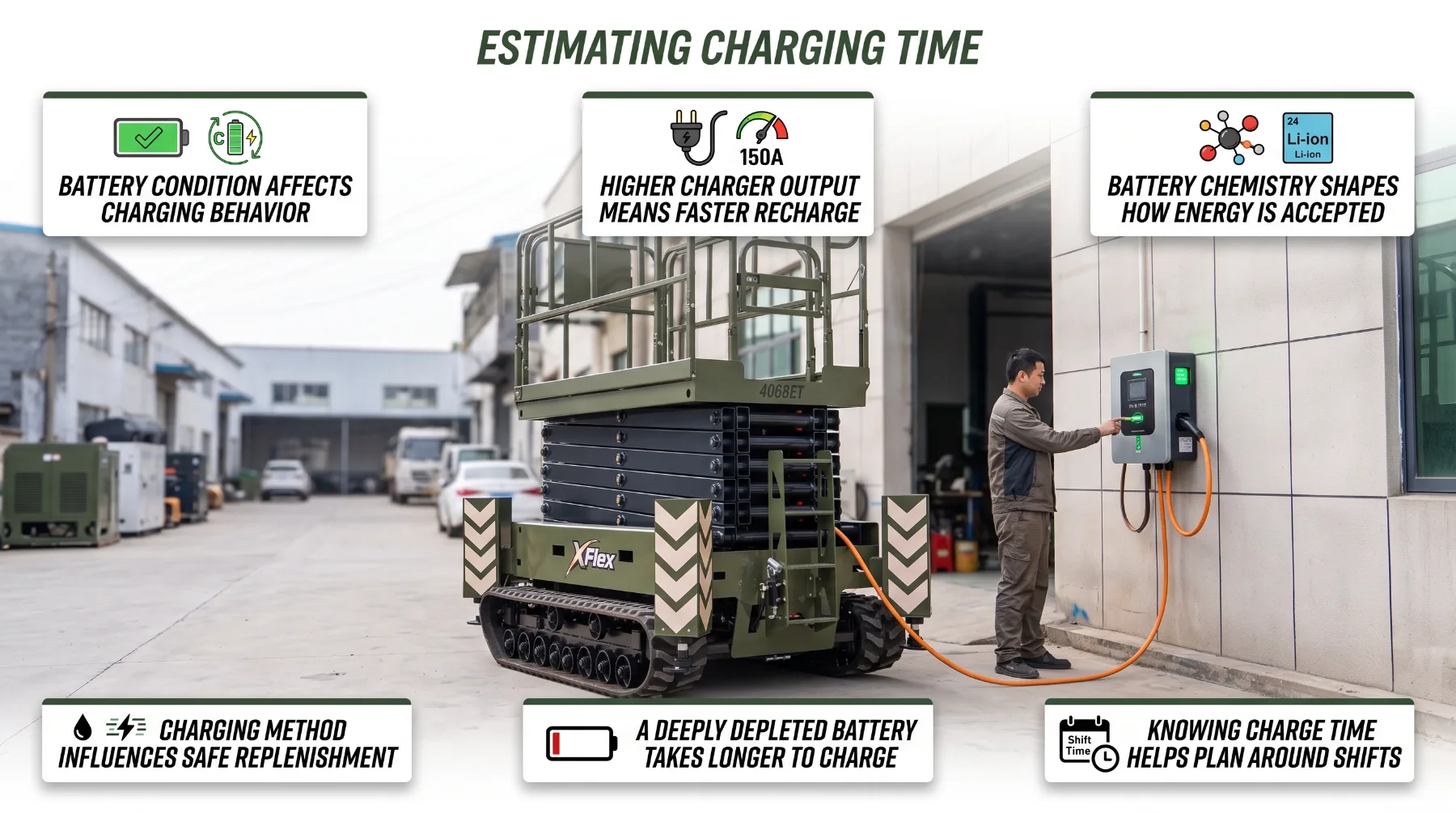
Charging time determines how quickly an electric scissor lift can return to service after its battery is depleted. The actual time can vary depending on the battery, charger, charging method, and how much energy remains when charging begins. Understanding these factors helps operators plan charging periods around the work schedule instead of treating battery charging as an afterthought.
- Battery condition: A new, healthy battery may charge differently from an older or worn battery. Battery condition can affect both charging behavior and the time needed to reach a full charge.
- Charger output: Charger capacity directly affects how quickly energy can be restored. A higher-output charger can generally recharge a compatible battery faster than a lower-output unit.
- Battery chemistry: Different battery types have different charging characteristics. Chemistry affects how the battery accepts energy and how the charging process should be managed.
- Charging method: The charging system and procedure used by the lift can influence charging time and how quickly the battery can safely be replenished.
- Remaining battery level: A heavily depleted battery takes longer to recharge than one that still has a significant amount of usable energy. The starting charge level is therefore an important factor in daily planning.
- Daily work planning: Knowing the typical full-charge time for the specific lift and charger makes it easier to schedule charging between shifts or work periods, helping keep the machine available when the crew needs it.
Key takeaway: Charging time depends on battery condition, charger output, chemistry, and how depleted the battery is, so knowing your machine’s real charge time is essential to planning daily use.
Calculating Shift Runtime
The rated capacity on a spec sheet is a starting point, not a promise, because actual runtime depends heavily on how the machine is worked. A lift running gentle indoor cycles will stretch its charge far longer than one pushed hard all day, even with an identical battery. The work itself sets the pace at which the reserve drains, and a realistic runtime estimate has to account for that.
Several conditions drive energy consumption up. Frequent platform lifting draws heavily on the battery, since raising the deck is one of the most demanding functions the machine performs. Long travel distances between work areas, heavy loads on the platform, rough or uneven surfaces, and repeated repositioning all add to the drain. By contrast, lighter indoor work with fewer lift cycles, short travel, and smooth floors lets a single charge last much longer. The practical lesson is to base runtime expectations on the intensity of the actual job, not the best-case rating, so the crew plans around what the lift will really deliver on this site, doing this work.
Key takeaway: Real shift runtime depends on lift frequency, travel distance, load, and surface conditions, so demanding work drains a battery far faster than the rated capacity suggests.
Managing Power During Work
Once the lift is on the job, operator habits have a direct effect on how far a single charge stretches. Efficient operation does not mean working slower; it means avoiding the wasted energy that quietly drains the battery over a long shift. Small, disciplined choices add up across hundreds of cycles, and they can be the difference between finishing the day on one charge and stopping short.
The most useful habits are straightforward. Limiting excessive travel by planning routes and staging work reduces unnecessary drive drain. Avoiding needless lift cycles, such as raising and lowering the platform more than the task requires, conserves energy for the work that matters. Shutting down the equipment during extended idle periods, when the manufacturer’s operating procedures permit, keeps the control systems from drawing power while no one is using the machine. None of these steps compromise safety or output, yet together they meaningfully extend runtime and help the lift stay available through the full shift.
Key takeaway: Efficient operator habits, like limiting travel, avoiding unnecessary lift cycles, and shutting down during long idle periods, reduce wasted battery drain and extend usable runtime.
Planning Charging Between Shifts
Charging is most reliable when it is scheduled around when the machine is next needed, not left to chance. The right charging plan depends on how the lift is used across the workday, and matching the schedule to that pattern keeps the machine ready without disrupting the crew.
A scissor lift used for a single daytime shift is the simplest case. It can typically be recharged during scheduled downtime, over a break, or after the workday ends, giving the battery a full, unhurried charge before the next morning. Multi-shift operations demand more planning. When a lift has to cover back-to-back shifts, there may not be a long window to charge, so planned charging periods have to be built into the schedule, or the operation has to accept shorter charging windows and manage runtime accordingly. Either way, the goal is the same: align charging with the machine’s next job so it never returns to work with less energy than the shift ahead requires.
Key takeaway: Charging schedules should match the lift’s usage pattern, with single-shift machines charged during downtime and multi-shift machines needing planned charging periods built into the workday.
Maintaining Battery Performance
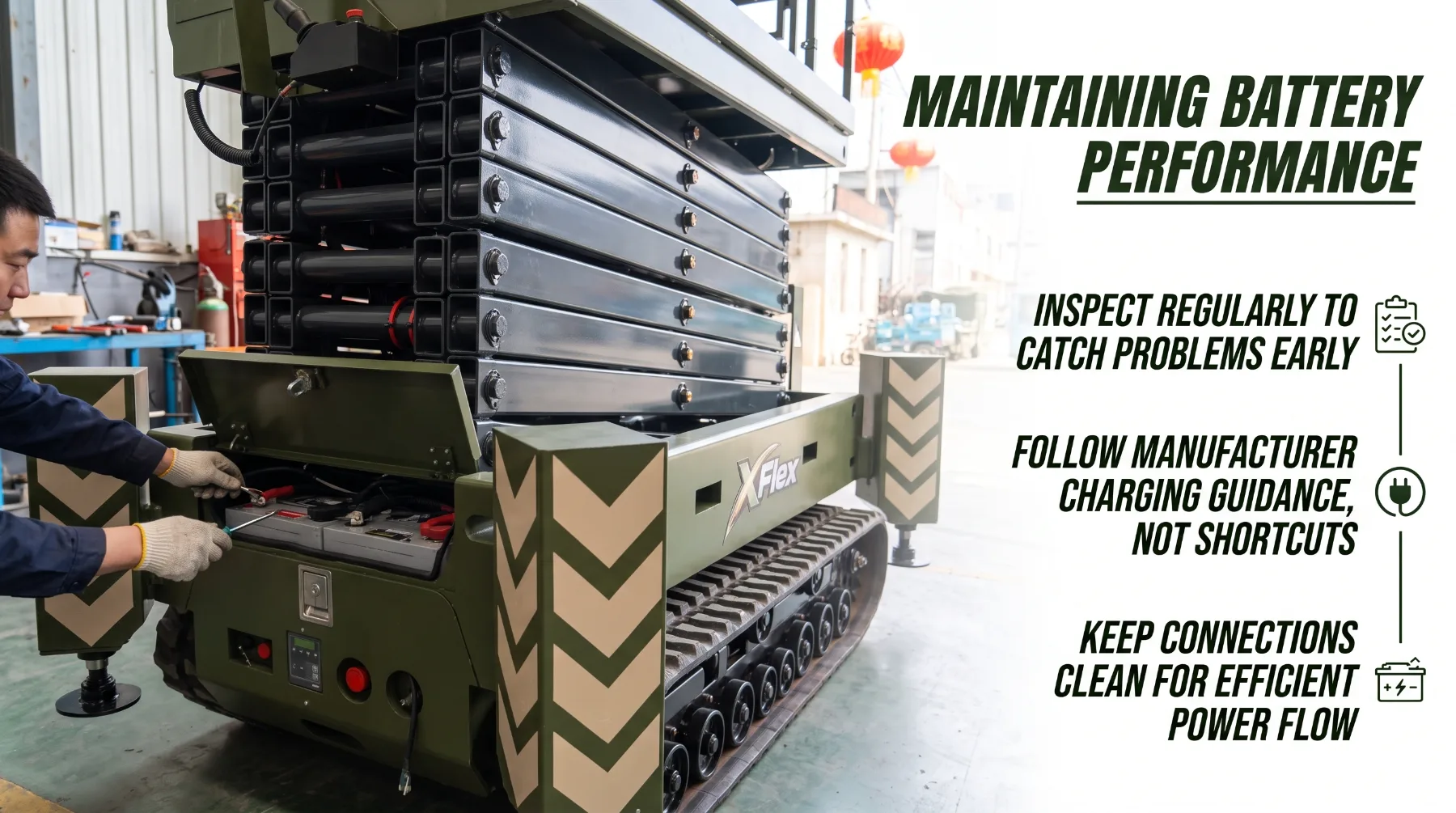
A battery’s condition has a direct, ongoing effect on how much runtime it delivers, and steady maintenance is what keeps that runtime consistent over the machine’s service life. A well-maintained battery holds closer to its rated capacity for longer, while a neglected one loses usable energy and forces more frequent charging, cutting into the availability the crew depends on.
Good maintenance covers a few reliable habits. Regular inspections catch problems early, before they reduce performance or shorten battery life. Proper charging practices, following the manufacturer’s guidance rather than improvising, protect the battery from the wear that comes with poor charging. Keeping connections clean ensures energy flows efficiently between the battery and the machine, since corroded or loose connections waste power and cause trouble. Above all, adhering to the manufacturer’s battery maintenance requirements ties these habits together into a routine that supports dependable performance shift after shift. Treated this way, the battery stays a reliable asset rather than a recurring source of downtime.
Key takeaway: Regular inspections, proper charging, clean connections, and following manufacturer maintenance requirements keep a battery delivering consistent runtime throughout its service life.
Conclusion
Battery capacity, charging time, and operating duty cycle are interdependent factors that determine how long an electric scissor lift can operate between charges. Battery voltage and amp-hour capacity establish the stored electrical energy available to the traction motors, hydraulic lift system, and control circuits, while actual runtime depends on how quickly that energy is consumed during lifting, travel, acceleration, and other machine functions. Higher lift frequency, heavier platform loads, longer travel distances, inclines, and rough surfaces can increase motor current and reduce usable runtime. Charging time depends on battery chemistry, state of charge, battery condition, charger output, and charging efficiency, so a larger battery does not necessarily provide the most practical operating schedule if recharge periods are limited. Operator technique can also affect energy consumption through travel speed, acceleration, unnecessary repositioning, and repeated lift cycles. Battery inspections, correct charging procedures, clean electrical connections, and proper thermal management help maintain consistent capacity and reduce charging losses as the battery ages. Electric scissor lift selection should therefore consider usable battery capacity, charging time, expected shift duration, lift frequency, payload, travel requirements, terrain, and available charging windows to ensure the machine can meet the intended duty cycle without unexpected downtime.
Frequently Asked Questions
How long can an electric scissor lift run on one charge?
Runtime depends on battery capacity, machine model, and how the lift is used. Frequent platform lifting, long travel, heavy loads, and rough surfaces drain the battery faster. Light indoor work with short travel and fewer lift cycles can extend runtime. For accurate planning, base expectations on your actual workload rather than the best-case rating.
How long does a scissor lift battery take to charge?
Charging time depends on the battery type, charger output, battery condition, and how depleted it is. A nearly empty battery takes longer to charge than a partially used one. Check the manufacturer’s specifications for your machine and charger, and follow the recommended charging procedure to plan work around the available charge time.
What uses the most battery power?
Frequent platform lifting is one of the biggest sources of battery consumption. Long travel, repeated repositioning, heavy platform loads, and rough or uneven surfaces also increase energy use. Planning travel routes and avoiding unnecessary lift cycles can help conserve power and extend runtime.
How can scissor lift battery runtime be maintained?
Follow the manufacturer’s charging procedure and keep battery connections clean and secure. Inspect the battery system regularly to catch problems before they reduce capacity or runtime. Limiting unnecessary travel and lift cycles also reduces energy use and helps maintain consistent performance over the battery’s service life.