Currently Empty: $0.00

Advanced Road Roller Techniques for Highway Construction
Executing a successful highway construction project requires managing an incredible number of variables, from unstable weather conditions to strict municipal regulations. However, the final quality of any major roadway ultimately comes down to the critical final step of compaction. When contractors and equipment buyers invest millions into heavy machinery and premium materials, they expect a highway surface that will withstand decades of heavy commercial traffic and severe environmental stress. Achieving this standard of durability is never an accident. It requires operators to apply advanced road roller techniques that transform loose soils and hot asphalt into a dense, monolithic structure. When compaction is approached as an exact science rather than a simple driving task, construction businesses deliver superior results that command respect in the industry. This guide explores the advanced techniques required to achieve optimal density, ensuring your projects consistently meet stringent engineering specifications while protecting your profit margins.
Selecting the Appropriate Roller for the Material
The foundation of any highway begins deep within the earthwork, far below the final driving surface. Every layer of a highway profile features distinct material characteristics, from the native subgrade up through the crushed stone base and the final hot mix asphalt. A frequent and costly error occurs when contractors attempt to use a single type of compaction equipment across all these varied materials. Utilizing a smooth drum roller on wet clay, for example, merely seals the top layer while leaving the material beneath completely uncompacted. This fundamental mismatch between machinery and material immediately guarantees poor density results, leading to severe settlement issues and costly delays before paving can even begin.
The definitive solution begins with matching your compaction equipment specifically to the material being placed. Cohesive soils, such as heavy clay and silt, require the deep kneading action of a padfoot or sheepsfoot roller. The tapered pads penetrate the soil, building density from the bottom up while allowing moisture to escape. Conversely, granular materials like crushed gravel and sand rely on the sheer weight and dynamic energy of a smooth drum vibratory roller to force the angular stones together. When the project transitions to the final asphalt surface, contractors must deploy specialized tandem vibratory rollers for the initial breakdown passes, followed closely by pneumatic tire rollers that knead the asphalt to seal the surface against water intrusion.
Making the correct equipment selection delivers an immediate and massive impact on your project’s overall business performance. Operating the right machine for the specific soil or asphalt type drastically reduces the number of passes required to achieve target density. This heightened efficiency translates directly into lower daily fuel consumption, reduced machine wear, and accelerated project timelines. Furthermore, eliminating the need to rip up and rework failing sections of the subbase protects your budget from unexpected labor and material costs. Once the correct machine is mobilized on the site, operators must then focus carefully on how much material they are attempting to compact at one time.
Managing Lift Thickness for Deep Compaction
Compacting highway materials requires a deep understanding of how physical force travels through soils and aggregates. Even the heaviest, most technologically advanced road roller has a physical limit to how deeply its compressive energy can penetrate. To build the required elevation of a highway, dump trucks and pavers must place the material in successive layers. A major limitation arises when site managers, eager to accelerate the production schedule, allow operators to place these materials in excessively thick layers. When a lift is too thick, the roller’s energy dissipates near the surface. This creates a dangerous condition known as bridging, where the top few inches form a rigid crust while the material beneath remains loose and unstable.
Preventing this structural failure requires strict adherence to engineered lift thickness guidelines. As a standard industry practice, contractors must restrict uncompacted lifts of soil and aggregate to depths that the specific roller can easily penetrate. For standard granular base materials compacted by a heavy vibratory roller, this typically means placing lifts no thicker than eight to twelve inches. When dealing with hot mix asphalt, the margin for error is even smaller, with lift thicknesses generally kept between two and three inches depending on the nominal maximum aggregate size of the mix. Site supervisors must work closely with grading operators and paving crews to ensure an even, consistent depth is maintained across the entire width of the lane before the roller makes its initial pass.
Managing lift thickness with absolute precision directly secures the long-term pavement longevity of the highway. A roadbed constructed with uniform, dense lifts creates an unyielding foundation that refuses to rut or shift under the punishing weight of commercial freight trucks. For the construction business owner, delivering this level of structural integrity completely eliminates the threat of devastating warranty claims and reputation-damaging callbacks. While properly sizing the lift ensures vertical density, the operator must concurrently manage the horizontal coverage of the machine.

Executing Precise Rolling Patterns
Highway lanes are significantly wider than the drums of the rollers tasked with compacting them, necessitating multiple side-by-side passes to cover the entire work area. Compaction is a cumulative process, meaning every square inch of the material must receive a uniform amount of applied energy. A pervasive problem on fast-paced job sites is the execution of erratic or random rolling patterns. When an operator simply drives back and forth without a strategic plan, they inevitably leave certain strips of the lane under-compacted while over-compacting others. Furthermore, stopping or reversing the roller abruptly in the middle of a hot asphalt mat creates deep transverse depressions, commonly known as bow waves, which ruin the ride quality of the highway.
Professional operators eliminate these defects by executing highly structured, disciplined rolling patterns. The standard technique dictates that the roller must always begin its passes at the lowest point of the road’s transverse slope—typically the outside edge—and systematically work its way upward toward the crown. This prevents the heavy machinery from pushing the loose material downhill. Operators must ensure a consistent overlap of at least six to twelve inches on every successive pass to guarantee no area is missed. Additionally, when reversing direction, the operator should steer slightly to the side on the previously compacted material, slowly easing out of the pass to prevent indenting the fresh mat.
Implementing these precise patterns dramatically improves overall productivity and compaction quality. Uniform coverage guarantees that core samples taken by municipal inspectors will consistently meet or exceed the required density specifications, allowing the project to proceed without administrative delays. A structured approach also enhances job site safety, as predictable machine movements allow ground personnel and other equipment operators to navigate the work zone securely. Beyond the steering wheel, mastering compaction requires an understanding of the invisible forces generated by the machine’s internal mechanisms.
Optimizing Vibration Frequency and Amplitude
Modern road rollers are not merely heavy static weights; they are sophisticated machines designed to generate dynamic forces that manipulate the granular structure of the material. The vibratory system inside the drum utilizes rotating eccentric weights to impact the ground rapidly, reducing internal friction and allowing particles to slide into their tightest possible configuration. However, applying vibration incorrectly causes immediate destruction. If the impact force is too violent for a thin layer of asphalt, the drum will literally bounce off the mat, shattering the aggregate and fracturing the pavement. Conversely, if the vibration is too rapid and shallow on a deep lift of soil, the machine will fail to achieve the required density at the bottom of the layer.
Operators must actively manage the roller’s frequency and amplitude settings based on the specific material and lift thickness. Amplitude dictates the height the drum jumps off the ground, representing the sheer downward force of the impact. Frequency measures how many times the drum impacts the ground per minute. For deep, thick lifts of soil or heavy aggregate base, operators should select a high amplitude and low frequency setting to drive the energy deep into the earth. When the project moves to paving, the strategy flips. Thin lifts of hot mix asphalt require low amplitude and high frequency settings. This rapid, gentle tapping consolidates the asphalt smoothly without fracturing the fragile stones or causing the surface to ripple.
Mastering these vibratory settings yields a profound return on investment by maximizing project cost control and equipment longevity. Applying the correct dynamic force allows operators to achieve passing density in fewer passes, saving thousands of hours in labor and machine depreciation over the life of a highway project. Furthermore, preventing the roller from violently bouncing against a hardened surface protects the machine’s sensitive hydraulic mounts and vibratory bearings from catastrophic failure. In asphalt applications, this mechanical knowledge must be paired perfectly with environmental awareness.
Timing Compaction with Asphalt Temperatures
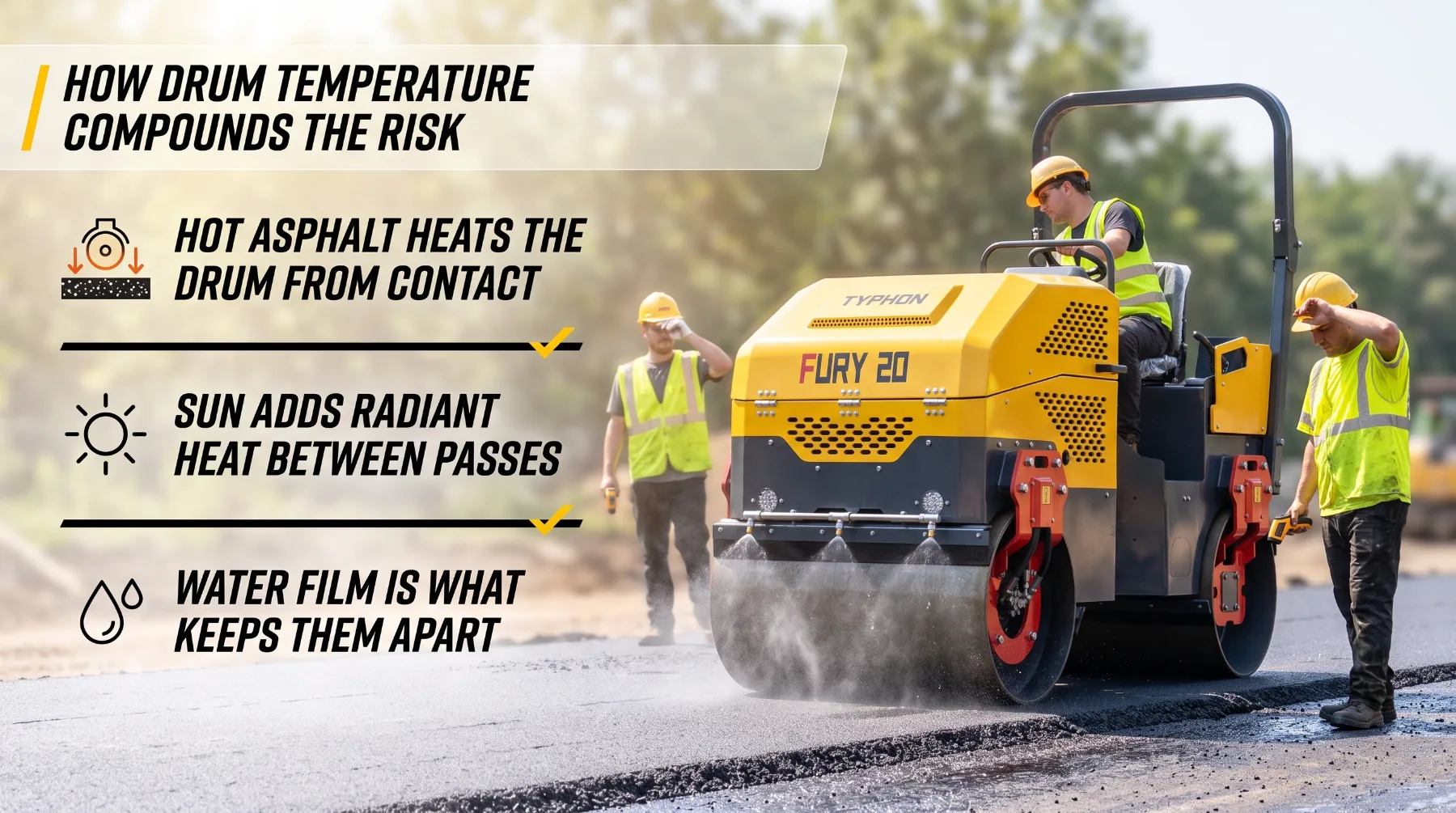
Unlike dirt or crushed gravel, hot mix asphalt is a time-sensitive material whose ability to be compacted relies entirely on its internal temperature. As the asphalt leaves the screed of the paver, it immediately begins releasing heat into the atmosphere and the base layer below. The critical limitation paving crews face is the rapidly closing window of workability. If the operator attempts to roll the asphalt while it is too hot, the mix becomes tender and shoves violently under the drum, tearing the surface open. If they wait too long and the temperature drops below the cessation point, the asphalt hardens into an immovable solid, making further compaction impossible and guaranteeing premature pavement failure.
The solution is a carefully choreographed sequence of compaction that tracks the declining temperature of the mat. The breakdown roller must follow closely behind the paver, engaging the asphalt while it remains in its optimal compaction temperature zone—typically between 275 and 300 degrees Fahrenheit. This initial phase does the heavy lifting, achieving the vast majority of the required density. As the temperature drops, the intermediate roller—often a pneumatic tire machine—takes over to knead the aggregate tightly together and seal the surface voids. Finally, when the asphalt cools to roughly 150 degrees, a static steel drum roller makes the finishing passes to iron out any remaining tire marks and deliver a perfectly smooth, glass-like finish.
Adhering strictly to these temperature zones guarantees exceptional pavement longevity and directly protects the contractor’s bottom line. Municipalities and departments of transportation frequently tie contract payouts to the final density of the asphalt. By perfectly timing the rolling sequence, contractors consistently hit their target densities, securing lucrative performance bonuses and avoiding massive financial penalties. Delivering a durable, perfectly smooth highway also builds immense trust with project owners. Ensuring this level of perfection, however, increasingly relies on modern technology.
Enforcing Quality Control and Intelligent Compaction
Historically, verifying the density of a compacted highway surface involved a significant degree of guesswork followed by delayed testing. Supervisors would estimate the number of passes required, and a technician would later arrive with a nuclear density gauge to spot-check random locations. This limitation meant that if a section failed the density test, the material had already cooled or the subsequent layers had already been placed. Fixing the mistake required extremely expensive and time-consuming rework. Contractors could no longer afford to rely on blind passes and delayed reporting when multi-million dollar highway contracts were on the line.
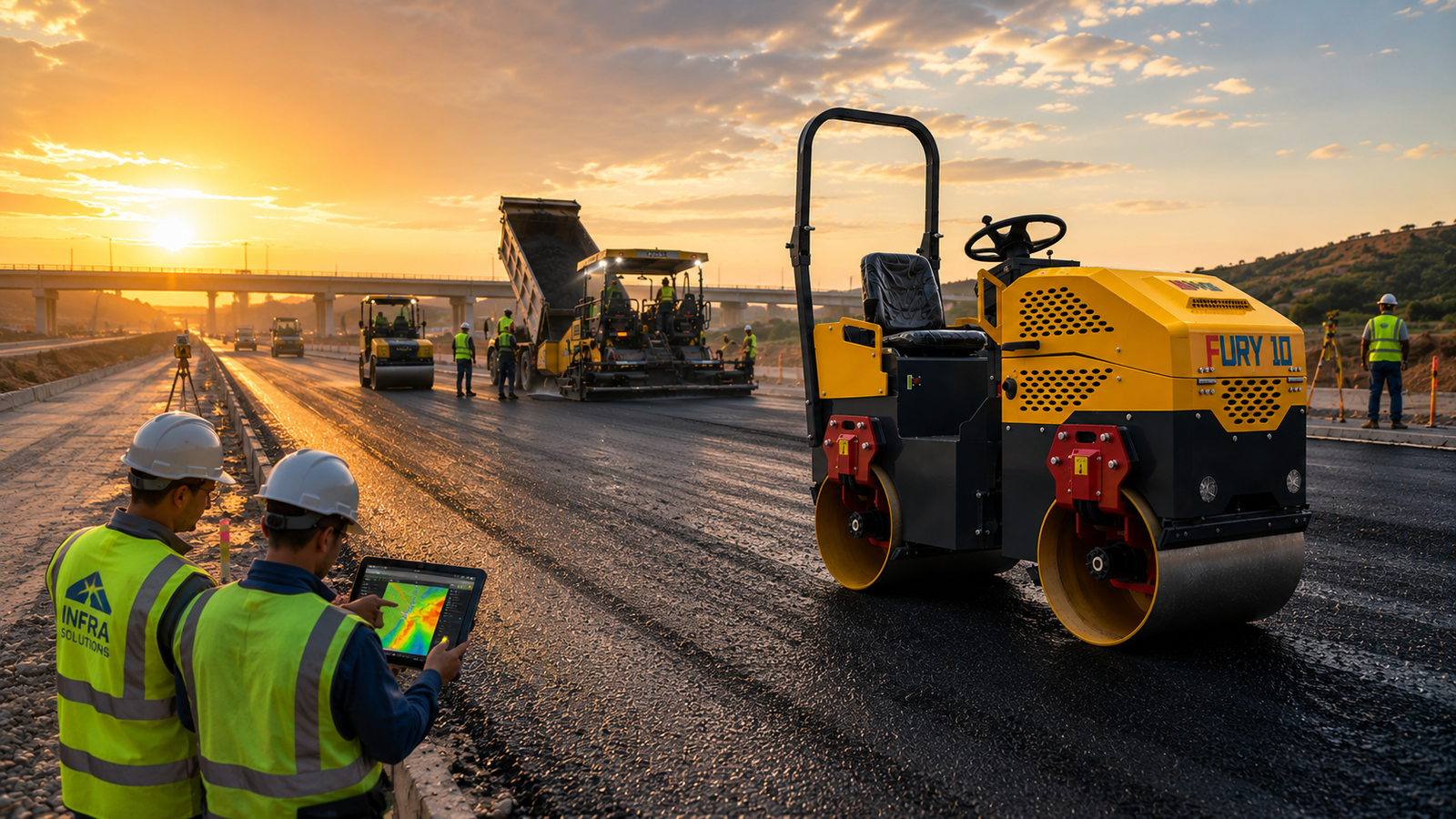
The industry standard has shifted toward the adoption of Intelligent Compaction technology. Modern road rollers are equipped with advanced sensors, GPS mapping, and onboard computers that provide operators with real-time feedback. The drum’s sensors continuously measure the stiffness of the material below, displaying a color-coded map on a screen inside the cab. This allows the operator to see exactly which areas have reached optimal density and which spots require an additional pass. The GPS system tracks the exact rolling pattern, ensuring complete coverage and eliminating the risk of uncompacted gaps. If a soft spot in the subgrade is detected, the system alerts the operator immediately, allowing the crew to excavate and repair the weak area before expensive asphalt is ever laid down.
Integrating Intelligent Compaction systems transforms a contractor’s ability to control project costs and guarantee absolute quality. Site managers gain access to verifiable, digital records of the entire compaction process, providing irrefutable proof of quality to municipal inspectors and project stakeholders. This transparency accelerates the approval process and ensures faster payouts. By eliminating over-compaction, saving fuel, and preventing catastrophic rework, advanced technology ensures that the compaction phase becomes a highly profitable, predictable component of the construction process.
Conclusion
Building a highway that endures the relentless demands of modern transportation is a profound responsibility that rests heavily on the shoulders of the paving and earthwork crews. The techniques applied from the seat of the road roller represent the final, decisive moments that determine whether a roadway will survive for decades or crumble within its first year. By carefully matching the equipment to the material, enforcing strict lift thicknesses, and executing disciplined rolling patterns, contractors eliminate the fundamental errors that plague amateur operations. Mastering vibratory settings and asphalt thermodynamics further elevates the final product to a standard of genuine excellence.
For construction business owners and equipment buyers, prioritizing these advanced compaction techniques is a strategic necessity that drives profitability and market dominance. Investing in operator training and Intelligent Compaction technology completely removes the guesswork from highway construction, replacing it with measurable, repeatable success. When your organization commits to mastering the science of the road roller, you deliver infrastructure that stands as a testament to your reliability, establishing your business as the premier choice for the most demanding projects in the industry.