
Currently Empty: $0.00
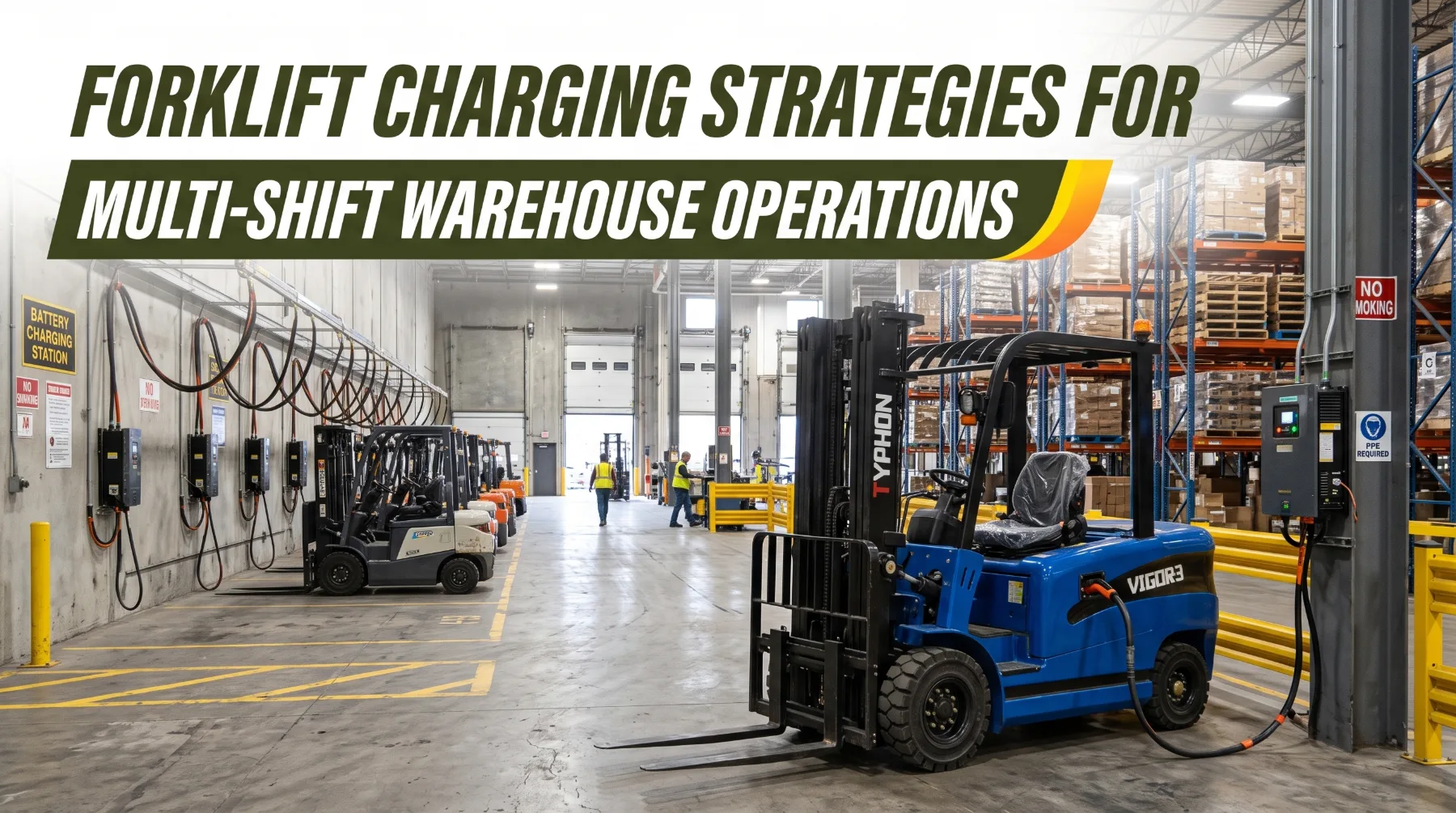
Forklift Charging Strategies for Multi-Shift Warehouse Operations

Warehouse productivity depends on having enough electric forklifts available to handle receiving, pallet storage, order replenishment, and outbound loading. In facilities operating multiple shifts or around the clock, limited charging windows can make equipment availability harder to manage. Without a coordinated plan, forklifts may run low on battery power during busy periods, disrupting material flow and delaying orders.
An effective charging schedule must account for battery chemistry, charger compatibility, daily workload, and operating hours across each shift. Breaks and shift changes can provide opportunities for charging, but opportunity charging is suitable only when the battery and charging system support it. Charging locations, electrical capacity, and manufacturer requirements also influence how safely and efficiently a fleet can be managed.
Consistent planning helps balance forklift availability with long-term battery condition. Fleet supervisors should coordinate charging times with operational demand, monitor battery status, and ensure operators use compatible chargers according to manufacturer instructions. Clear shift handovers, regular battery inspections, and organized charging areas help reduce downtime, control replacement costs, and maintain safe warehouse operations.
Understanding Battery Type and Charging Needs
Choosing the right charging strategy starts with understanding the battery type used in each forklift. Lead-acid and lithium-ion batteries have different charging requirements, maintenance needs, and operating limits. Identifying these differences helps supervisors develop a schedule that supports daily workloads while protecting battery performance. This is especially important in warehouses that operate multiple shifts or use a combination of battery technologies, since one charging method may not be suitable for every machine.
Lead-acid batteries typically require several hours for a full charge, followed by a cooling period before returning to heavy use. They generally perform best when fully charged according to the manufacturer's recommendations, rather than repeatedly receiving partial charges unless designed for that practice. Operators must also avoid excessive discharge, monitor battery temperature, and maintain proper watering and equalization schedules for flooded batteries. Because charging can release hydrogen gas, suitable ventilation and ignition control are essential. In multi-shift operations, fleets often use spare batteries and approved battery-changing equipment to keep forklifts working while depleted batteries complete their charging and cooling periods.
Lithium-ion batteries often offer greater charging flexibility because many models support partial charging and faster charging when paired with compatible equipment. They do not require watering or routine equalization, and their battery management system (BMS) monitors conditions such as voltage, temperature, and charge level. However, charging speed and permitted operating conditions depend on the battery design, charger compatibility, and manufacturer requirements. Charging outside approved temperature or voltage limits can damage the battery and create safety risks. Other battery types, including maintenance-reduced lead-acid models, may have different requirements as well. Always follow the specific manufacturer's instructions instead of applying one charging schedule to every battery in the fleet.
Key takeaway: Identify the chemistry and design of every battery in your fleet, recognize that lead-acid batteries typically need full charging cycles, cooling, and watering while some lithium-ion systems support more flexible charging, and follow each manufacturer's limits rather than applying one charging rule to all batteries.
Planning Charging Around Shift Changes
A charging plan only works if it reflects how forklifts are actually used. In multi-shift operations, demand rarely stays constant. The morning shift may handle heavy inbound receiving. The afternoon shift may focus on picking and replenishment. The night shift may load outbound trailers with a smaller crew. Each pattern places different demands on the fleet.

Map Forklift Usage Across All Shifts
Start by building a clear picture of fleet use. For each forklift, identify:
For each forklift, identify the assigned tasks, including receiving, put-away, picking, replenishment, shipping, or general support, along with how long each machine actually runs per shift, not just how long it is assigned. Note the peak demand periods when the most forklifts are needed, such as dock appointments, wave picking, and outbound cutoffs, as well as the low-demand periods when some machines can be taken offline without affecting production. Also factor in break and meal schedules, which create predictable windows when operators step away, and shift overlaps, when crews hand over and some machines may be idle.
Operating hour meters, fleet management systems, and battery monitoring data provide more accurate information than estimates. Review data over several weeks to capture normal variation, seasonal peaks, and day-of-week patterns.
With this map, you can identify when machines can be taken out of service for charging. These windows form the foundation of the charging schedule.
Stagger Charging Where Possible
Charging every forklift at the same time is one of the most common causes of availability problems. When the whole fleet goes on charge at shift change, the next shift may start with too few charged machines, or charger capacity may be overwhelmed.
Stagger charging where possible so enough forklifts remain available for loading, picking, and replenishment. Practical approaches include:
Rotating charging groups divide the fleet so that some machines are always working while others charge. Aligning charging with low-demand windows keeps critical forklifts on the floor when they are needed most. Spreading charger use prevents all chargers from being occupied at once while other machines queue. In lead-acid swapping operations, tracking which batteries have completed charging and cooling ensures the next swap always uses a ready battery.
Staggered charging can also reduce peak electrical demand, which may lower energy costs where utility rates include demand charges. Review your facility's electrical capacity and utility rate structure as part of the plan.
Protect Critical Machines
Some forklifts matter more than others at certain times. A specialized reach truck that serves high racking, a forklift equipped with a unique attachment, or the only machine rated for heavy loads can become a bottleneck if it is unavailable.
Avoid allowing several critical machines to become unavailable at the same time. Steps that help include:
Start by listing machines whose absence would stop or slow key operations. Schedule those machines in separate charging windows rather than grouping them together, and where possible, keep a spare machine or spare battery available for the most critical tasks. Before any high-demand period begins, confirm that these machines are fully charged and ready.
Build a Written Schedule
Turn the plan into a clear, written charging schedule. It should show which machines or batteries charge when, where they charge, and who is responsible. Post it in the charging area and share it with supervisors and operators on every shift. Review the schedule regularly and adjust it as workloads, fleet size, and shift patterns change.
Key takeaway: Map forklift use across every shift to find realistic charging windows, stagger charging so enough machines remain available, schedule critical forklifts separately, and turn the plan into a written schedule that every shift follows.
Opportunity Charging and Battery Limits
Opportunity charging uses suitable breaks or downtime to add charge during the workday. Instead of waiting for a battery to run low and then charging fully, operators connect the forklift to a charger during breaks, meal periods, shift overlaps, or other planned pauses. Done correctly, opportunity charging can keep forklifts running across multiple shifts without battery swapping.
Use Opportunity Charging Only With Approved Systems
Opportunity charging is appropriate only for battery systems designed to support that practice. This point cannot be overstated. Many lithium-ion systems are built for frequent partial charging. Some lead-acid batteries are specifically designed for opportunity charging when paired with the correct charger and charging profile. Many conventional lead-acid batteries are not designed for it.
Using opportunity charging on a battery that does not support it can cause serious problems:
Frequent partial charges can increase cycle counts, heat buildup, and wear on batteries not designed for them. Repeated charging without adequate cooling can push battery temperatures beyond safe limits, while some lead-acid batteries may never reach a full charge under this pattern, leading to sulfation and capacity loss over time. Charging practices that fall outside the manufacturer's guidance may also affect warranty coverage.
Before introducing opportunity charging, confirm with the battery and charger manufacturers that the system is approved for it. Do not allow operators to plug in at every break unless the battery system supports that practice.
Follow Charge Rate Limits
Each battery has a maximum charge rate set by its design and chemistry. Chargers used for opportunity charging are often configured to deliver higher charging current to add meaningful charge in short windows. That current must stay within the battery's limits. Use only charger settings and profiles approved for the specific battery, and do not modify charger settings without manufacturer guidance.
Respect Temperature Conditions
Temperature affects charging safety and battery health:
High temperatures are a key concern because charging generates heat, and in warm warehouses or with frequent charging cycles, battery temperatures can rise quickly, accelerating wear and triggering protective shutdowns. At the other extreme, many lithium-ion batteries have restrictions on charging below certain temperatures and may not accept a charge at all until they warm up, making cold storage and freezer operations a specialized case that requires batteries, chargers, and procedures designed for those conditions. Lead-acid batteries approved for opportunity charging may also still require adequate rest and cooling periods between sessions, as specified by the manufacturer.
Follow the battery manufacturer's guidance for permitted charging temperatures. Where the battery management system restricts charging because of temperature, do not attempt to bypass it.
Key takeaway: Use opportunity charging only with battery and charger systems approved for that practice, stay within the manufacturer's charge rate, temperature, and frequency limits, and never let short charges replace required full or equalization charges.
Charger Compatibility and Charging Locations
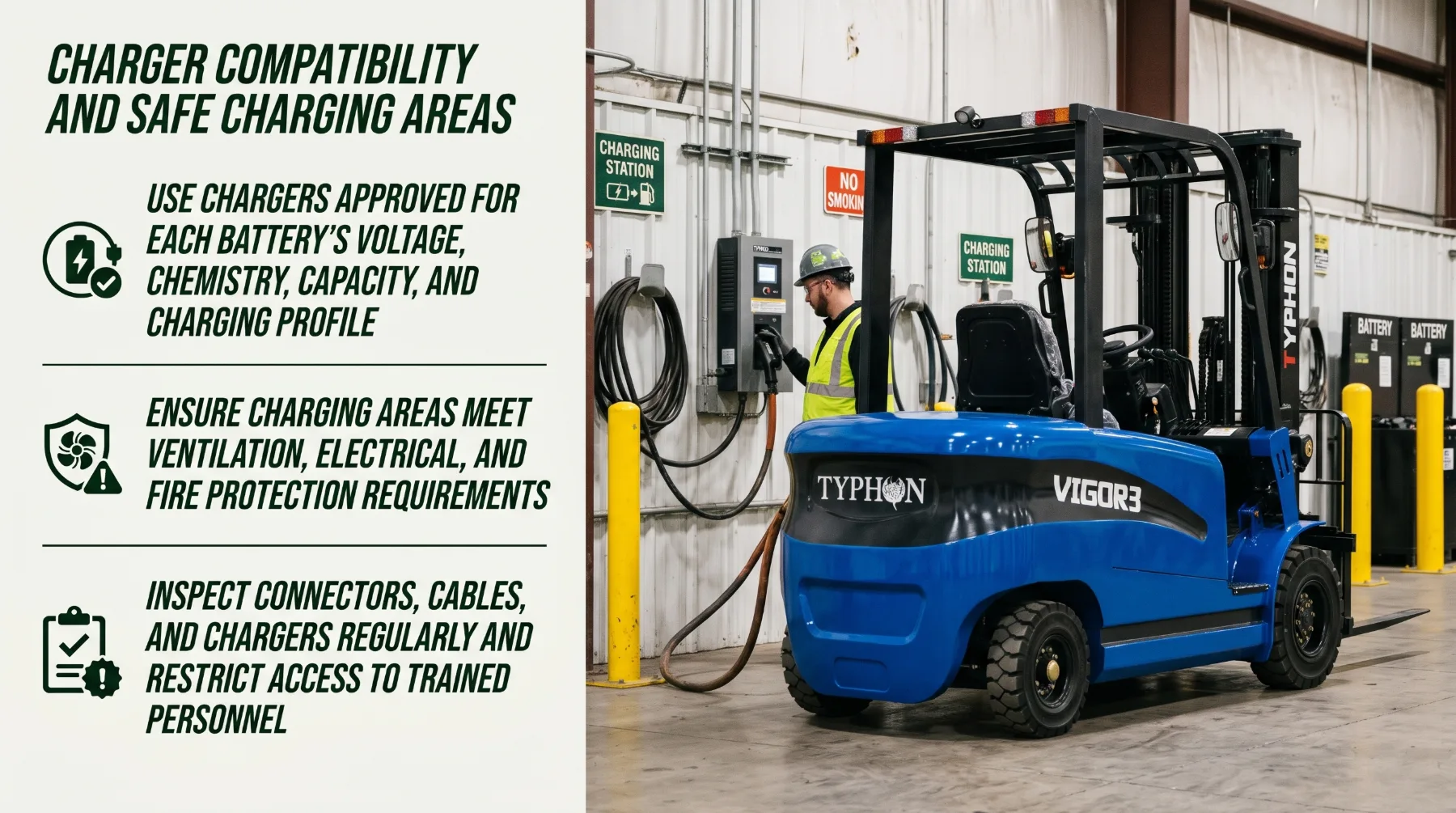
A battery and its charger must be compatible to ensure safe, reliable charging and long service life. Always use a charger approved for the battery's voltage, chemistry, capacity, and charging requirements. Lead-acid and lithium-ion batteries use different charging methods, so a charger designed for one type should not be used with another unless the manufacturer confirms compatibility. Check the charging profile and any communication requirements between the charger and the battery management system (BMS). Clearly label batteries and chargers to prevent mix-ups, and allow only trained personnel to connect equipment or change charger settings. Using unapproved adapters or incorrect charging settings can damage the battery, reduce performance, and create safety hazards.
A properly designed charging area helps protect workers and equipment. Ensure the space meets applicable electrical, ventilation, fire protection, and access requirements for the battery type being used. Lead-acid batteries can release hydrogen during charging, so adequate ventilation and strict control of ignition sources are essential. Provide appropriate fire protection equipment, clear safety signs, and enough space for forklifts to enter, park, and leave safely. Charging stations should be protected from vehicle impacts, while cables and connectors must remain clear of traffic routes. Facilities that service flooded lead-acid batteries also need suitable protective equipment, eyewash stations, and spill response materials. Use approved lifting equipment when changing heavy batteries rather than attempting to lift them manually.
Regular inspection of chargers, cables, and connectors helps prevent electrical faults and charging interruptions. Check connectors for cracks, corrosion, burned contacts, discoloration, or melted sections. Inspect cables for cuts, exposed wires, crushing, and worn insulation, and make sure charger ventilation openings remain clean and unobstructed. Unusual noises, error codes, or signs of overheating should be investigated promptly. Remove damaged equipment from service and arrange repairs or replacement by qualified personnel using approved parts. Operators should never pull cables to disconnect batteries or disconnect charging connections under load. Follow the manufacturer's shutdown and disconnection procedure to reduce the risk of electrical arcing, equipment damage, and fire.
Key takeaway: Use chargers approved for each battery's voltage, chemistry, capacity, and charging profile, design charging areas that meet ventilation, electrical, fire protection, and access requirements, and keep connectors, cables, and chargers in good condition with access limited to trained personnel.
Maintenance and Shift Handover
Proper battery maintenance supports efficient charging, reliable performance, and longer service life. Lead-acid batteries require regular watering, cleaning, and inspection according to the manufacturer's instructions. Use the specified water quality, avoid overfilling, and follow the recommended watering schedule to prevent electrolyte spills. Keep battery surfaces clean and dry, and check cases, terminals, cables, connectors, and vent caps for damage or corrosion. Equalization charging should only be performed when required by the manufacturer. Record all maintenance activities for each battery, and ensure workers use suitable protective equipment, including eye protection, acid-resistant gloves, and aprons. Eyewash facilities and spill response materials should also be available wherever lead-acid batteries are serviced.
Lithium-ion batteries do not require watering, but they still need regular monitoring and inspection. Review battery management system (BMS) alerts, temperature readings, charge levels, and fault codes to identify potential problems. Check the battery case, cables, and connectors for damage, swelling, corrosion, or signs of overheating, and keep ventilation openings free of dust and debris. Any unusual heat, odor, smoke, or physical damage should be reported immediately, and the battery should be handled according to the manufacturer's safety procedures. Never open a lithium-ion battery pack or attempt internal repairs unless specifically authorized and qualified to do so. Following the correct maintenance procedures for each battery type helps reduce safety risks and prevent avoidable equipment failures.
Clear communication between shifts is equally important for maintaining an effective charging routine. At every handover, record which batteries are fully charged, currently charging, cooling, or waiting for charging, along with charger availability, reported faults, completed maintenance, and upcoming service requirements. Identify any battery, charger, or forklift that has been removed from service and explain the reason so another shift does not return it to operation accidentally. Use a shared log, digital checklist, or fleet management system to keep this information accessible. Operators and supervisors should also receive regular training on charging procedures, battery inspections, safe connections and disconnections, low-charge warnings, and fault reporting. Consistent maintenance, accurate records, and effective shift communication help keep batteries safe, healthy, and ready for daily forklift operations.
Key takeaway: Follow approved watering, cleaning, inspection, and equalization procedures for lead-acid batteries, monitor and inspect lithium-ion batteries without ever opening the packs, and include charge status, charger availability, faults, and maintenance in every shift handover.
Conclusion
Multi-shift forklift charging works best when the schedule reflects battery type, actual workload, and available charging windows. Understanding the differences between lead-acid and lithium-ion batteries sets the foundation, since each chemistry has its own needs for charging cycles, cooling, watering, and charge flexibility. Mapping forklift use across every shift reveals realistic charging windows, while staggered charging and separate scheduling for critical machines keep enough forklifts on the floor during peak demand. Opportunity charging can extend availability, but only for battery systems approved for it and only within the manufacturer's limits for charge rate, temperature, and frequency.
Compatible chargers and safe charging areas protect both batteries and people. Matching chargers to each battery's voltage, chemistry, capacity, and profile, and providing proper ventilation, electrical supply, fire protection, and access, keeps charging reliable and safe. Monitoring charge level, operating hours, charging time, and battery condition lets supervisors adjust to real conditions rather than fixed assumptions. Finally, consistent maintenance and clear shift handovers make sure every shift inherits a fleet that is charged, maintained, and ready.
When you build your charging strategy around these practices, you protect your battery investment, control energy and replacement costs, and keep your warehouse moving shift after shift.
FAQs
Can every forklift battery use opportunity charging?
No. The battery and charger must be specifically approved for that charging method. Many lithium-ion systems and some lead-acid batteries are designed for opportunity charging when paired with the correct charger and charging profile. Conventional lead-acid batteries that are not designed for it can suffer shortened service life, overheating, and capacity loss. Confirm approval with the battery and charger manufacturers before introducing opportunity charging.
Should forklifts be charged during every shift break?
Only when the battery system supports that practice and the manufacturer's charging limits are followed. Batteries approved for opportunity charging may benefit from charging during breaks, provided charge rates, temperature conditions, and frequency limits are respected and any required full or equalization charges still take place. Batteries not designed for opportunity charging should follow their approved full-charge schedule instead.
How can a warehouse avoid charging delays?
Stagger charging, monitor battery status, and plan charger access around shift demand. Map forklift use across every shift to find realistic charging windows, divide the fleet into rotating charging groups, and schedule critical machines separately. Battery monitoring systems help supervisors see which machines need charging before a shift begins, and clear shift handovers prevent the next crew from starting with depleted batteries or unavailable chargers.
Can one charger be used for different forklift batteries?
Only if it is compatible with each battery's specifications and approved by the manufacturer. The charger must match the battery's voltage, chemistry, capacity, and charging profile, and lithium-ion systems may also require communication between the battery and charger. A matching connector does not confirm compatibility. Label chargers and batteries clearly, and restrict charger use and settings to trained personnel.