Currently Empty: $0.00
Static and Vibratory Compaction Methods for Road Construction
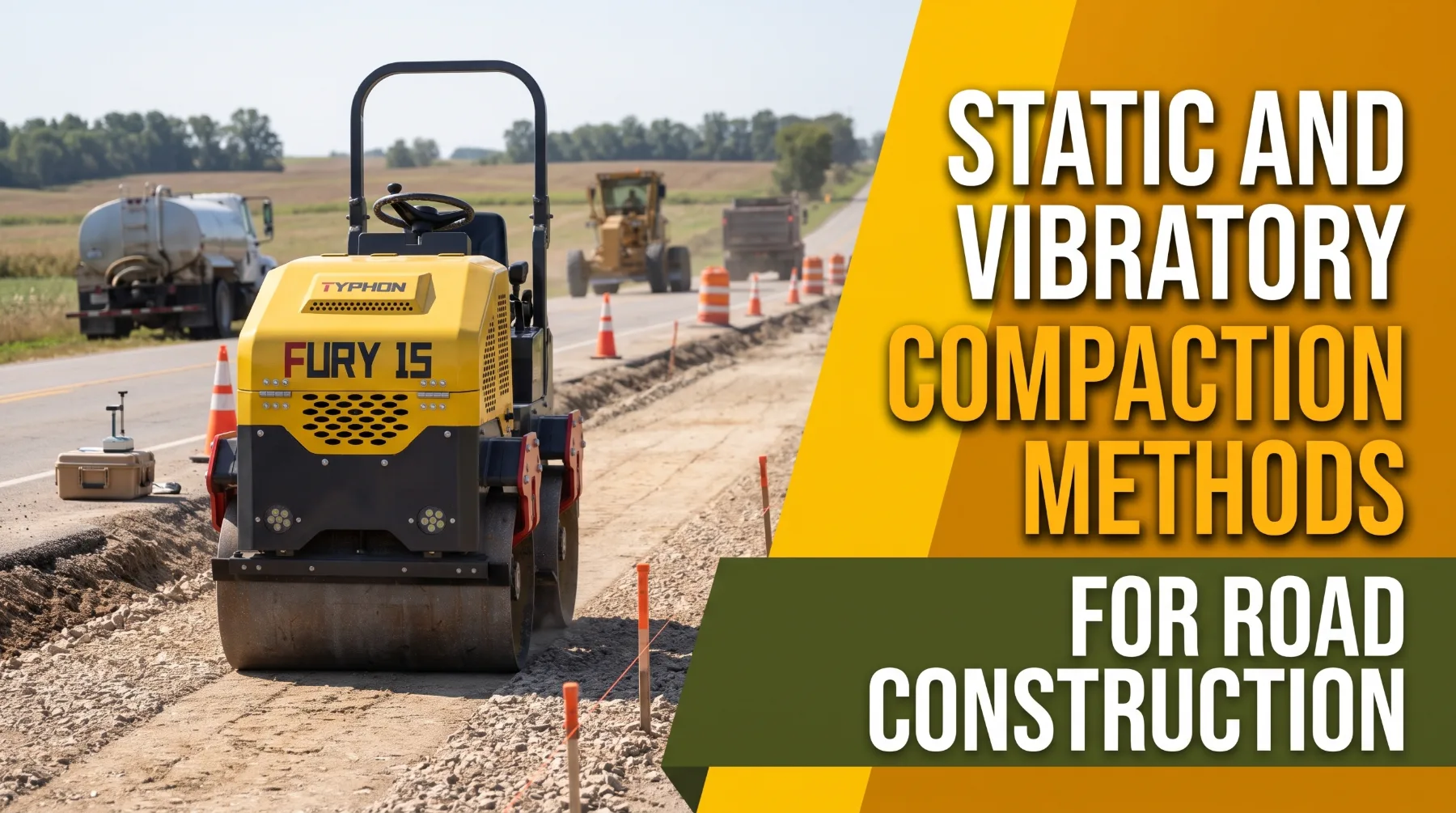
A county road widening project reaches its aggregate base stage on a warm, dry morning. The grading crew spreads a thick loose lift of crushed limestone across the new lane, and the roller operator makes several passes with vibration on high amplitude. The surface looks tight and hard, and the drum barely leaves a mark. The next morning, the quality-control technician runs density tests at several locations. The top few inches pass easily, but readings taken deeper in the lift fall short of the specification. One test near the edge fails outright. The crew scarifies the section, adds water, and rebuilds it in two thinner lifts. The roller wasn't the problem. Lift thickness, moisture, and the rolling method weren't matched to the material.
Compaction is one of the most important steps in road construction. It increases the density of soil, aggregate base, and asphalt, reduces air voids, and gives each layer the strength to carry traffic loads without rutting, settling, or cracking. Poor compaction rarely shows up on day one. It appears months or years later as potholes, depressions, edge failures, and premature resurfacing, often at a cost far greater than the original work.
Road rollers achieve density in two main ways. Static compaction relies on the machine's weight pressing down through its drums or tires. Vibratory compaction combines that weight with rapid mechanical impacts generated inside the drum. Each method has strengths, limits, and materials it suits best. Throughout, project specifications, the roller manufacturer's operator's manual, and applicable regulations remain the primary reference for every machine and every job.
How Static Compaction Works
Weight is the foundation of static compaction. A static roller presses material into a denser arrangement using nothing more than the load carried through its drums or tires. As the roller passes, that load pushes particles closer together, squeezes out air, and increases the material's density near the surface.
Steel-drum roller performance is often described by static linear load, which is calculated by dividing the weight carried by the drum by the drum's width. Comparing static linear load figures gives a more useful picture of compaction effort than total machine weight alone, since weight spread across a wider drum applies less pressure per unit of contact than a narrower drum carrying the same load.
Static rolling suits several common tasks, including finish rolling asphalt to remove roller marks and produce a smooth surface, compacting thin asphalt lifts where vibration could crush aggregate or crack the mat, sealing the surface of aggregate base after vibratory rolling, working on bridge decks and near buried utilities where vibration isn't permitted, and proof rolling to locate soft spots in subgrade. Static compaction has limits. Its effect decreases with depth, so thick lifts often stay under-compacted at the bottom, and it usually requires more passes than vibratory rolling to reach the same density in granular material.
Key takeaway: Static rollers compact through weight alone, so compare drum linear load or tire contact pressure rather than total weight, and use static rolling for finish work, thin lifts, sensitive areas, and surface sealing.
How Vibratory Compaction Improves Density
Inside every vibratory drum sits an eccentric weight mounted on a rotating shaft. When a hydraulic motor spins that shaft, the off-center weight generates a centrifugal force that drives the drum up and down many times per second. Each downward movement delivers an impact into the material, in addition to the drum's static weight.
Repeated impacts briefly reduce friction between particles. For a moment, sand, gravel, and crushed stone behave almost like a fluid, allowing particles to slide past one another and settle into a tighter arrangement. Static pressure alone often can't overcome that friction, especially in coarse granular material. Vibration also sends compaction energy deeper into the layer, which is why vibratory rollers can compact thicker lifts than static rollers of similar weight.
Two settings control how vibration behaves. Amplitude is how far the drum moves up and down. High amplitude delivers more energy and reaches deeper, which suits thick soil and aggregate lifts. Low amplitude delivers lighter, more frequent impacts that suit asphalt and thinner layers. Frequency is how many times the drum vibrates per unit of time. Soil compactors and asphalt rollers operate at different frequency ranges suited to their materials, and the manufacturer's specifications define the appropriate settings for each machine. Most vibratory rollers offer at least two amplitude settings, and many allow frequency adjustment. Some newer machines adjust amplitude automatically based on the material's response. Oscillating drums, which move back and forth rather than up and down, offer another option for sensitive areas and thin asphalt lifts. The type of drum for each application depends on the material and compaction requirements. Single-drum rollers are commonly used for soil, gravel, crushed stone, and aggregate compaction, making them suitable for road subgrades, embankments, and foundations. Their front steel drum delivers compaction force, while the rear tires provide traction and stability. Double-drum rollers are primarily used for asphalt paving, road surfaces, parking lots, and other applications requiring smooth, even compaction. Both steel drums provide consistent surface coverage, while some models can also compact granular materials and base layers, depending on their design and specifications.
On asphalt, impact spacing describes how many vibratory impacts the drum delivers per foot of travel. The relationship between vibration frequency and travel speed determines this figure, and hitting a consistent target range produces a smooth surface without visible ripples. When a roller travels too fast relative to its vibration frequency, impacts spread too far apart, which can leave a washboard pattern and uneven density. Speed and frequency must always be set together.
Vibration doesn't suit every situation. It can crush aggregate in thin or cooled asphalt, crack mats that are too stiff, disturb nearby structures and utilities, and cause the drum to bounce on material that has already reached density. Vibration should be switched off on bridge decks unless the specification permits it, near sensitive buildings, and whenever the material stops responding.
Key takeaway: Vibratory rollers use an eccentric weight to drive repeated impacts that rearrange particles and reach deeper than static rolling, so set amplitude, frequency, and speed for the material and confirm that asphalt impact spacing stays within the target range.
Establishing Roller Passes and Operating Speed
Consistency across the entire work area is the goal of every rolling pattern. Density that varies from lane to lane or edge to center leads to uneven performance, early cracking, and failed tests. A planned pattern with controlled speed delivers uniform results.
Many specifications call for a test strip at the start of a job or when materials change. The crew compacts a section while testing density after each pass. Density typically rises quickly at first, then levels off. The number of passes at which further rolling adds little density becomes the target pattern for the rest of the job. A test strip also confirms the best amplitude, frequency, and speed for that specific material.
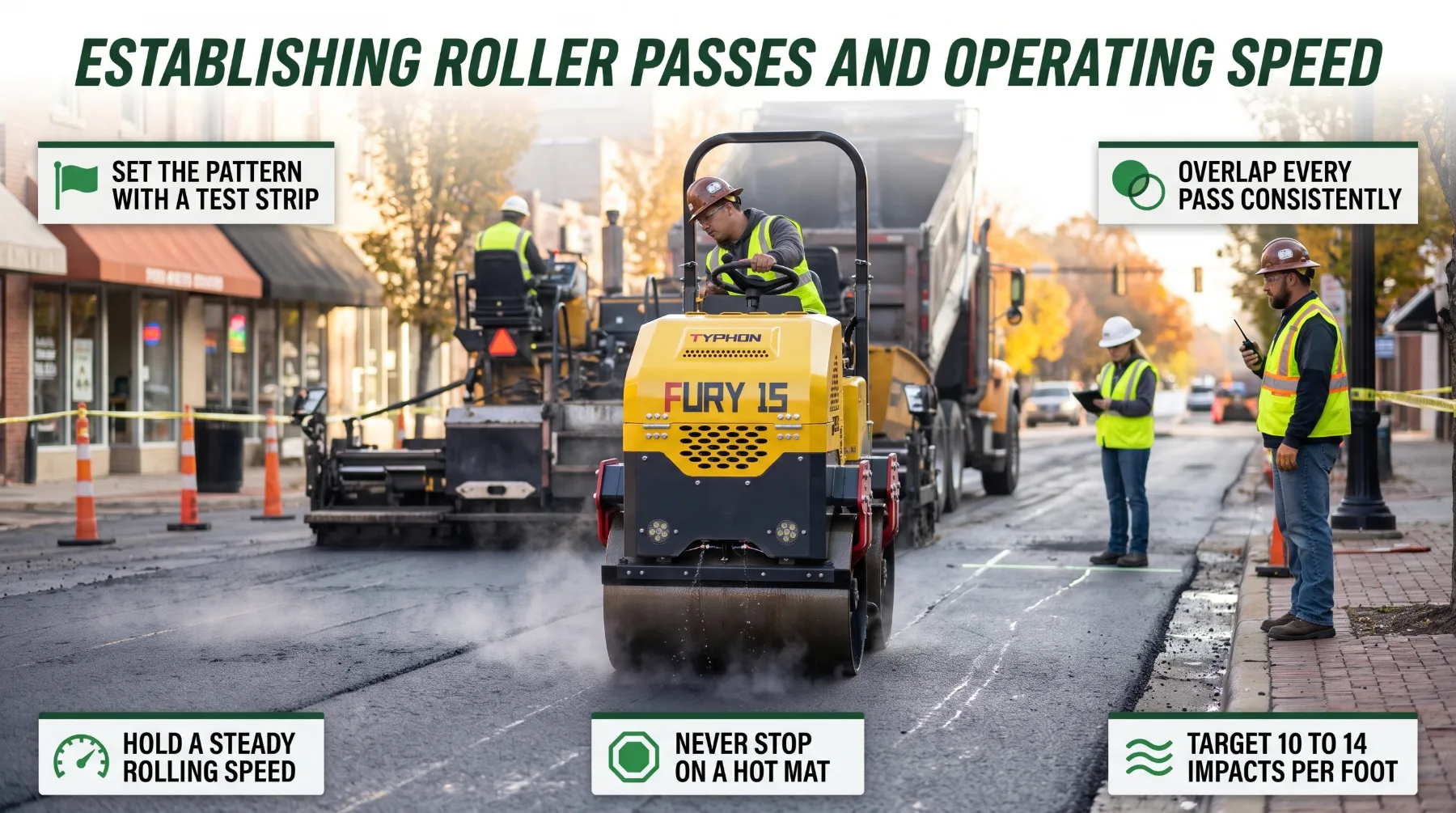
Overlap prevents missed strips between passes. On asphalt, a consistent overlap along each pass is standard, and on soil and aggregate, many crews overlap by a larger portion of the drum width. A practical rolling pattern rolls longitudinal joints and unsupported edges early following the specification's sequence, works from the low side of the section toward the high side so material isn't pushed downhill, overlaps each pass consistently, staggers stopping and turning points so the drum doesn't leave marks in a single line, and completes the pattern evenly across the full width before moving on.
Speed affects both density and surface quality. Excessive speed reduces the energy delivered per foot and, on vibratory rollers, spreads impacts too far apart. Very slow rolling compacts well but cuts productivity and, on asphalt, can keep the roller over one area while the rest of the mat cools. The test strip and manufacturer's guidance should set the final speed figure.
Hot asphalt demands smooth technique throughout. Never stop or park on a hot mat, since the drum leaves a depression. Switch off vibration before stopping or reversing, and switch it on again only after the roller is moving. Change direction smoothly and gradually without jerking the drum. Keep drums wet and clean to prevent asphalt pickup.
Key takeaway: Use a test strip to set the number of passes, amplitude, and speed, overlap consistently, roll edges and joints in the specified sequence, and operate smoothly on hot asphalt without stopping or vibrating in place.
Managing Lift Thickness and Moisture Content
Thickness and moisture decide whether compaction energy reaches the full depth of a layer. A roller can only compact so deep, and soil can only densify when its water content allows particles to move. Getting both right prevents the kind of failure described in the opening.
Every roller has an effective compaction depth. When a lift exceeds it, the top compacts while the bottom stays loose. Project specifications limit loose lift thickness based on the material and roller size. Lighter rollers require thinner lifts, while large vibratory soil compactors can handle thicker ones within those limits. Placing two thinner lifts often takes less total time than placing one thick lift that fails testing and must be rebuilt.
Asphalt lifts must be thick enough for aggregate to rearrange without crushing. A minimum lift thickness relative to the nominal maximum aggregate size is a widely used guideline, and lifts that are too thin cool quickly and are prone to aggregate fracture under vibration. The project specification sets the limits for each mix type.
Soil density depends heavily on water content. Too little water leaves particles bound by friction and resistant to movement. Too much fills the voids and keeps particles apart, causing the soil to pump or rut under the roller. Between those extremes lies the optimum moisture content, which laboratory Proctor testing establishes along with the maximum dry density. Specifications typically require field moisture within a narrow range of that optimum, and common test standards establish whether standard or modified Proctor applies.
Weather changes moisture quickly. Rain can push a ready lift far above optimum overnight, while hot, windy afternoons dry the surface fast. Check moisture before each rolling session, not just at placement. Soil that tests too wet needs to be aerated by disking or scarifying before rolling. Soil that tests too dry needs water applied evenly and mixed in before compaction begins.
Key takeaway: Keep lifts within the specification and the roller's effective depth, test moisture against the Proctor optimum, and dry or wet the material to the specified range before rolling.
Checking Compaction Results and Preventing Surface Damage
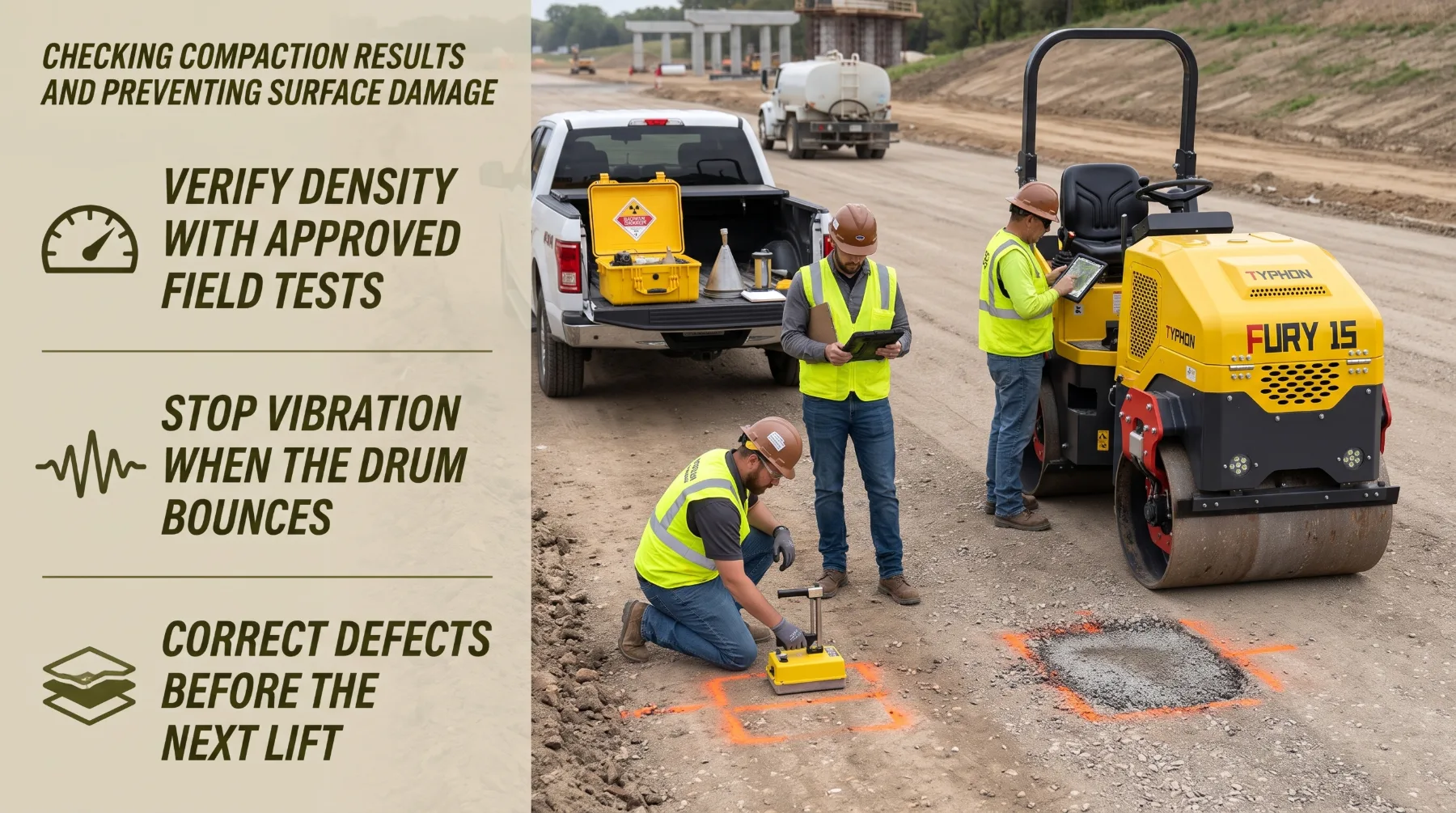
Density can't be confirmed by appearance. A surface that looks tight may hide a loose layer below, as the opening showed. Field testing confirms whether each layer meets the specification and gives the crew data to adjust its method before defects are buried under the next lift.
Several methods are widely used depending on the project type and specification. Nuclear density gauges measure in-place density and moisture quickly, though operators must be trained and licensed to use them. Sand cone tests provide a measurement without radioactive equipment. Non-nuclear gauges are accepted on some projects. Asphalt cores cut from the finished mat give laboratory-verified density. Proof rolling with a loaded truck or heavy roller reveals soft or yielding areas in subgrade and base. Intelligent compaction systems measure drum response and map compaction coverage across the entire area in real time. Always use the methods and targets stated in the project specification.
More rolling isn't always better. Once material reaches density, additional vibratory passes can cause harm. If the drum begins to bounce or jump, the material has stiffened and amplitude should be reduced or the roller switched to static. Fractured or crushed aggregate on the surface signals excess energy, a thin lift, or a cool mat. Surface waves or washboarding on asphalt usually means impact spacing is too wide or travel speed is too high. Hairline checking can result from rolling a mix at the wrong temperature. Shoving or displacement often points to a mix that is too hot or too abrupt direction changes. Pumping or rutting on soil signals moisture well above optimum. Reduce or stop vibration as soon as the material stops responding, test the area, adjust the method, and only then continue.
Key takeaway: Confirm density with approved field tests rather than appearance, compare results to the specification's targets, and reduce or stop vibration at the first sign of bouncing, aggregate crushing, waves, or surface movement.
Safe Operation, Leak Checks, and Lockout
Rollers work on loose fill, fresh asphalt, embankments, and live traffic lanes, often in tight spaces with other equipment and ground crews nearby. Rollover, struck-by incidents, and pinch points at the articulation joint are serious hazards. Disciplined safety practice protects everyone on the crew.
Wear the seat belt whenever the roller moves. The rollover protective structure protects the operator only when the operator stays inside it. Keep the roller well back from unsupported edges, trench lines, and embankment shoulders, since soft or freshly placed material can collapse under the drum. Travel straight up and down slopes within the manufacturer's limits, and never turn across a steep grade. Use a spotter in congested areas and confirm that backup alarms, lights, and mirrors work. Keep ground workers out of the roller's path and away from the articulation joint. Wear hearing protection where vibratory rolling noise requires it. Only trained, authorized operators should run the roller.
Hydraulic lines feed the drive motors, steering, and vibration motors on most rollers, often routed close to the drums and articulation joint. Never use your hand to search for a hydraulic leak. Fluid escaping through a pinhole under pressure can penetrate skin and cause an injection injury. The wound may look like a minor puncture at first, but it's a medical emergency that requires immediate surgical treatment. Hold a piece of cardboard or wood near the suspected hose, fitting, or motor. Wear gloves and eye protection, and keep your face and body out of line with the leak point. If anyone is struck by escaping hydraulic fluid, get emergency medical care at once and tell medical staff it's a hydraulic injection injury.
Before any inspection beyond the visual walk-around, and before every cleaning, adjustment, or repair, follow these steps. Park on firm, level ground away from traffic, edges, and the paving lane. Switch off vibration and bring the roller to a complete stop. Install the articulation lock exactly as the manufacturer instructs. Apply the parking brake and chock the drums or tires where required. Shut down the engine and remove the key. Disconnect battery power where the manual directs before electrical work. Relieve hydraulic pressure as the manufacturer instructs. Apply your personal lock and tag according to your site's lockout procedure, then verify isolation before starting work.
Let drums cool before touching them after asphalt work, since hot steel can cause serious burns. Never reach between the front and rear frames unless the articulation lock is installed and the machine is locked out. Remove the articulation lock before operating again, since steering is disabled while it's in place. Leave vibration system, drive motor, and hydraulic repairs to qualified technicians using the manufacturer's procedures and specified parts.
Key takeaway: Wear the seat belt, stay back from unsupported edges, check leaks with cardboard rather than your hands, and install the articulation lock and complete a full lockout before any service.
Conclusion
Static and vibratory compaction each play a distinct role in building durable roads. Static rollers compact through weight, making them the right choice for finish rolling, thin lifts, surface sealing, and areas where vibration isn't permitted. Vibratory rollers add repeated impacts that rearrange particles and reach deeper, which suits granular soils, aggregate base, and asphalt breakdown rolling. Matching the method to the material, then controlling lift thickness, moisture, amplitude, frequency, passes, and speed, determines whether each layer reaches its specified density.
Field testing turns that process into verified results, while watching for bouncing, crushing, and surface movement prevents over-compaction from damaging finished work. Crews that combine a sound rolling plan with test strips, accurate density testing, and disciplined safety practice, including cardboard leak checks and complete lockout, deliver road layers that perform as designed and stand up to traffic for years.
Frequently Asked Questions
What is the main difference between static and vibratory compaction?
Static compaction uses only the roller's weight to press material into a denser state. Vibratory compaction combines that weight with rapid impacts from a rotating eccentric weight inside the drum. Vibration briefly reduces friction between particles and sends energy deeper, so vibratory rollers usually reach density in fewer passes on granular materials and thicker lifts.
Is vibratory compaction suitable for every soil type?
No. Granular materials such as sand, gravel, and crushed stone respond well to vibration. Cohesive soils such as clay often compact better with padfoot or sheepsfoot rollers that knead the material, sometimes with vibration added. Vibration should also be reduced or avoided on thin asphalt lifts, cool mats, bridge decks, and areas near sensitive structures.
Why does lift thickness matter?
Every roller has an effective compaction depth. When a lift is too thick, the surface may compact while the bottom stays loose, and the layer fails density testing or settles later. Project specifications define acceptable lift thickness based on the material type, roller size, and compaction requirements.
How can contractors confirm compaction quality?
Use the field density tests the project specification approves, such as nuclear or non-nuclear gauges, sand cone tests, asphalt cores, or proof rolling. Compare results against the specified targets for each material and layer. Intelligent compaction systems can also map coverage across the full work area in real time.