Currently Empty: $0.00
How Engine Power Affects Wheel Loader Lifting Safety
A wheel loader looks unstoppable with a full bucket raised high, but that image hides a hard truth: the machine is only as safe at height as the engine feeding its hydraulics. Buyers study lift height, bucket capacity, and breakout force, then treat engine output as a background number that simply keeps the machine running. On a lift, that assumption becomes a safety problem. When the engine can’t sustain the power a loaded lift demands, the risks show up fast and dangerously.
Engine power is the source that drives every hydraulic function on the machine, and lifting a heavy load high is among the most demanding things you can ask of it. Fall short, and lift force sags, cycles falter, and control slips at the worst possible moment. In this post you’ll learn how engine power reaches the lift cylinders, why insufficient output compromises both force and stability, how combined demands strain a marginal engine, the specific safety risks a power shortfall creates, what chronic strain costs in fuel and wear, and how to match engine power to your real lifting work. The core takeaway: on a wheel loader, engine power isn’t just a performance figure, it’s a safety specification.
How Engine Power Drives the Hydraulic Lift System
A wheel loader doesn’t raise its load with the engine directly. The engine turns a hydraulic pump, and that pump pressurizes fluid routed to the lift and tilt cylinders that raise the boom and curl the bucket. Every pound of lifting force the machine produces begins as engine output converted into hydraulic power. When you pull back on the lift control, you’re really asking the engine to supply the pump with enough power to hold flow and pressure under a heavy load.
Two figures define what reaches the cylinders. Flow, measured in gallons per minute, sets how fast the boom rises and the bucket curls. Pressure, measured in PSI, sets how much weight those cylinders can lift and hold against gravity. The engine has to deliver enough power for the pump to sustain both together, because a loaded lift needs speed and force at the same time.
Here’s why that matters for safety: hydraulic horsepower, the product of flow and pressure, is what actually holds a load in the air. A loader with an impressive lift-height rating but a marginal engine can’t feed the pump enough power to sustain full pressure through a heavy lift. When the engine falls short, the hydraulics downstream weaken, and no amount of boom geometry recovers the force the engine never produced. A safe lift depends on an engine that never runs out of reserve while the load is up.
Why Insufficient Engine Output Compromises Lift Force and Stability
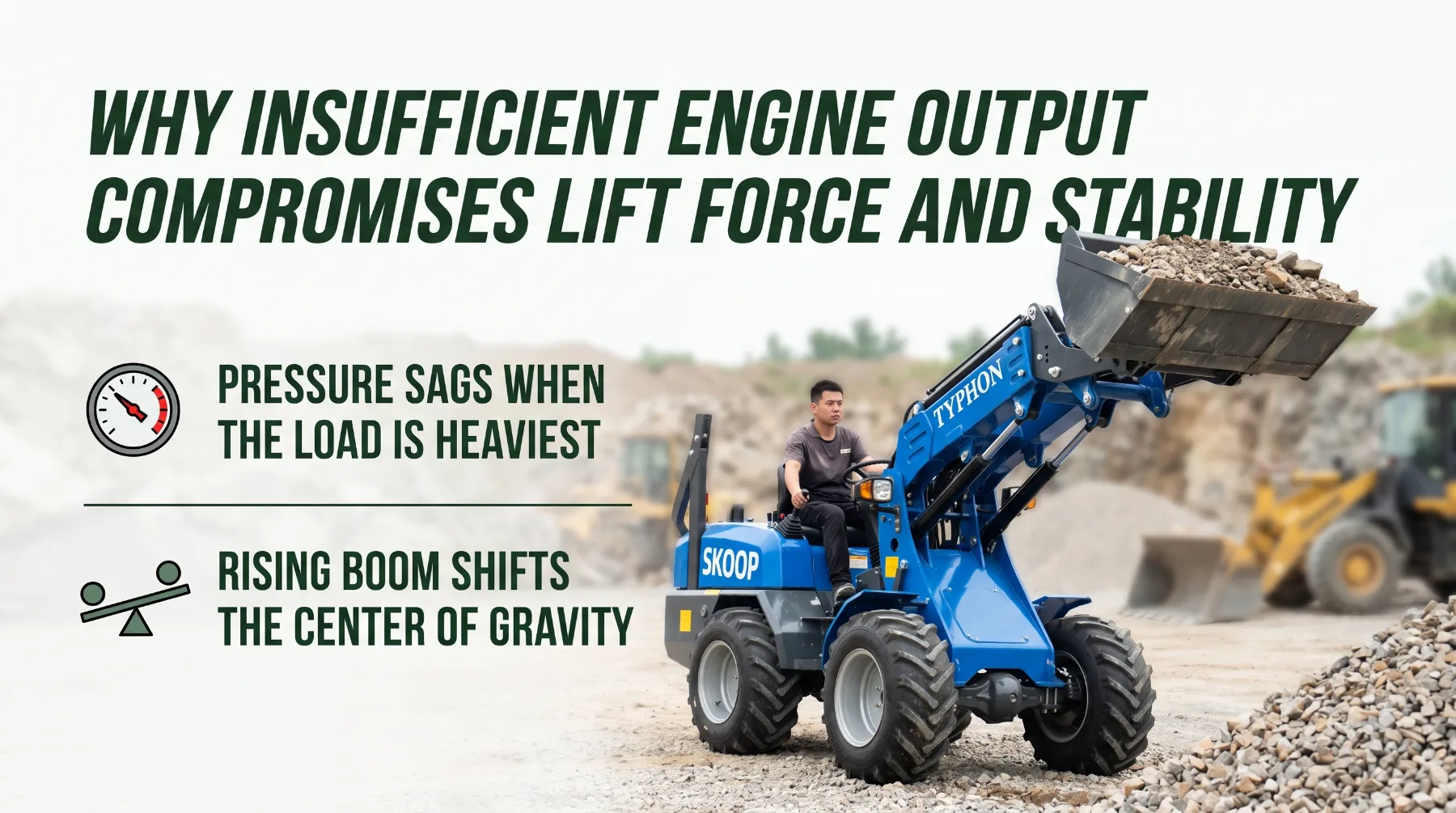
An underpowered engine betrays itself the moment the bucket carries real weight. Lifting a heaping load of dense material demands high hydraulic pressure, and if the engine lacks the reserve to keep the pump at full output, that pressure sags precisely when the load is heaviest. The boom slows, the lift hesitates, and in the worst cases the cylinders can’t hold what they’ve raised. What should be a smooth, controlled lift turns into a struggle the operator can feel through the controls.
The problem compounds because lifting changes the machine’s balance. As the boom rises and the load moves up and out, the loader’s center of gravity shifts forward and higher, reducing stability exactly when precise hydraulic control matters most. An engine that can’t sustain steady pressure produces jerky, uneven boom movement, and that jerkiness translates into load sway and shifting weight that strain an already-compromised stability envelope.
A properly powered loader raises a full bucket in one smooth, controlled motion and holds it rock-steady while the operator positions it over a truck bed. A marginal one lifts in fits and starts, sags under the weight, and forces the operator to fight the machine at height. The lifting problem isn’t a cylinder problem or a boom problem, it’s an engine that can’t sustain the pressure a safe lift requires.
How Combined Demands Strain a Marginal Engine
A wheel loader almost never lifts in isolation. In a real load-and-carry cycle, the operator raises the bucket while tramming toward a truck, steers to line up the dump, and holds the load steady through the whole maneuver. Every one of those actions draws on the same engine and the same hydraulic system at the same moment, and that combined demand is where engine capacity proves itself.
Picture a standard truck-loading cycle. The operator lifts the loaded bucket, drives forward across the yard, and articulates the steering to align with the target, all while keeping the boom rising and the load stable. On most wheel loaders, the steering is hydraulically assisted and the transmission draws engine power too, so lifting, traveling, and steering all pull from one finite output. An engine with ample reserve carries every demand without flinching. A marginal one is forced to ration.
The critical point: when the engine runs near its ceiling, combined demand forces a compromise, and that compromise is where safety erodes. Steer hard while lifting a heavy load and tramming, and something has to give. Lift speed sags, steering response goes soft, or the transmission loses drive, and the operator suddenly finds the machine less responsive than expected with a heavy load in the air. A loader that feels strong lifting while parked can still fall dangerously short during the combined demands of real work.
The Safety Risks When Engine Power Falls Short During Lifting
The consequences of a power shortfall during lifting aren’t just slower cycles, they’re genuine hazards. When hydraulic pressure sags under a load the engine can’t support, the boom can drift or lower unexpectedly, dropping a raised load without warning. Anyone working near the machine, and the operator’s confidence in the controls, both depend on the lift staying exactly where the operator puts it. Unexpected lowering turns a routine lift into a serious incident in an instant.
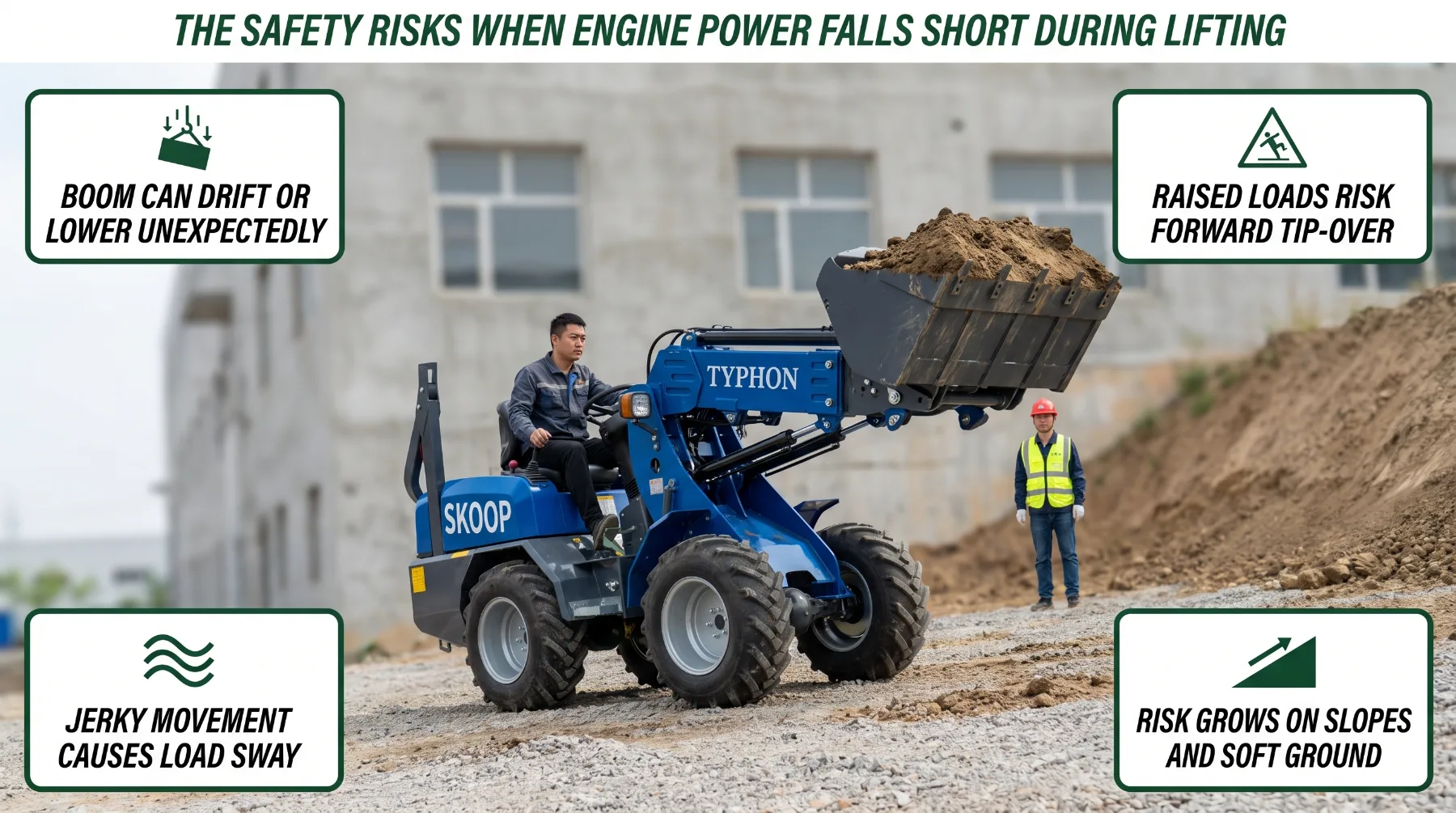
Stability is the second, and gravest, risk. A wheel loader tips forward when the load and boom position push its center of gravity beyond the front axle, and a raised load is far more prone to this than a low one. Jerky, underpowered boom movement produces load sway that can shove the center of gravity past the tipping point, especially on a slope, on soft ground, or during a turn. The hard truth: an engine that can’t hold steady hydraulic control at height makes tip-overs more likely precisely when a tip-over is most dangerous.
Loss of control ties these risks together. When lifting, steering, and traveling all fight for power the engine can’t supply, the operator may lose steering authority mid-maneuver, feel the transmission cut out on a grade, or watch the boom stall with a load overhead. Each of these is a moment where the machine stops doing what the operator commands, and with a heavy load elevated, those moments carry real potential for injury and damage. The bottom line: adequate engine power isn’t a comfort feature during lifting, it’s what keeps the load controlled, the machine stable, and the crew safe.
The Fuel and Wear Cost of Chronic Strain
A power shortfall punishes the budget as steadily as it punishes safety. An engine held near its ceiling to sustain heavy lifts burns fuel inefficiently, consuming more diesel per load moved than an adequately powered engine working comfortably within its efficient range. Across a season of production loading, that difference lands squarely on the fuel bill, shift after shift.
Heat is the next penalty, and it circles right back to safety. A laboring engine runs hotter and pushes hydraulic fluid past its efficient temperature range. Hot fluid transmits power less effectively and breaks down faster, so the very system responsible for controlled lifting gradually loses capability. Degraded fluid, stressed seals, and an overworked pump all mean weaker, less predictable lift performance over time, a slow erosion of the control margin every safe lift depends on.
The lasting cost: chronic strain ages the pump, seals, hoses, cooling system, and engine itself ahead of schedule, so a machine that starts marginal only grows more so with hours. An engine matched to the lifting work runs cooler, sips less fuel, and preserves the hydraulic precision that keeps lifting safe. An overtaxed one turns a modest specification gap into a compounding drain on fuel, maintenance, and safety margin all at once.
How to Match Engine Power to Real Lifting Requirements
Choosing a safe machine starts with an honest look at what you actually lift and how you handle it, not the easiest load on the lightest day. Begin by profiling your real work: the heaviest material you routinely carry, the height you lift it to, and how far you tram with the load raised. A loader sized for occasional light lifting will struggle and grow unsafe under constant heavy production, so match engine power to your most demanding realistic conditions.
Look past lift height and bucket capacity in isolation, because those numbers only describe what the machine can reach, not whether the engine can sustain the hydraulics to get there safely. Weigh breakout force, lift capacity through the full boom range, and hydraulic flow and pressure together, and give real weight to the engine’s ability to hold that output under combined load. A loader that pairs a strong, well-matched hydraulic system with genuine engine reserve is the one that lifts safely when the work stacks demands together.
Account for the full cycle and your duty rhythm. If your work pairs lifting with constant travel, hard steering, grades, or continuous truck loading across full shifts, you need reserve to cover all of it at once, plus thermal headroom so the hydraulics stay precise late in the day. Best of all, this decision costs nothing to get right in the planning stage. Test the loader on your actual material, lift a full bucket to working height while tramming and steering, and watch whether it holds smooth, steady control throughout. Steady, confident performance under genuine combined load is the clearest sign the engine is matched to the job, and to safe operation.
Conclusion
Wheel loader lifting performance depends on how effectively the powertrain and hydraulic system work together under load. During a heavy lift, the machine must generate enough hydraulic force to raise the bucket while keeping steering and travel controlled. If available output remains strong, the loader can lift smoothly and maintain predictable movement, while insufficient capacity can reduce lifting speed, weaken control response, and make raised loads harder to manage safely. Before choosing a wheel loader, consider the heaviest loads it will regularly handle and evaluate lift capacity, hydraulic flow, pressure, stability, and power reserve together. Testing the machine under realistic lifting conditions helps confirm whether it can maintain controlled, stable, and dependable performance throughout the work cycle.
Frequently Asked Questions
Why does my wheel loader’s boom lower or drift when I lift a heavy load?
When you lift a heavy load, the hydraulic system must generate high pressure to raise and hold it. If the engine lacks the reserve to keep the pump at full output, that pressure sags and the cylinders can’t hold what they’ve raised, so the boom drifts or lowers unexpectedly. Consistent lowering under heavy loads is a strong warning sign that the engine is underpowered for your lifting work, and it’s a genuine safety hazard that deserves immediate attention.
How does engine power affect wheel loader stability and tipping risk?
Lifting shifts the loader’s center of gravity forward and upward, reducing stability exactly when hydraulic control matters most. An underpowered engine produces jerky, uneven boom movement that causes load sway, and that sway can push the center of gravity past the tipping point, especially on slopes, soft ground, or during turns. An engine with adequate reserve delivers smooth, steady lift control that keeps the load stable and the machine within its safe operating envelope.
Can an underpowered engine really make lifting operations dangerous?
Yes. During lifting, an engine that can’t meet combined demand can cause unexpected boom lowering, soft or lost steering, transmission cutout on grades, and load sway that raises tipping risk. Each of these means the machine stops responding as commanded with a heavy load in the air, creating real potential for injury and damage. Adequate engine power keeps the load controlled, the machine stable, and the operator in command, which is why it should be treated as a safety specification, not just a performance figure.