Currently Empty: $0.00
Why Does Road Roller Weight Matter for Compaction?
Road rollers can share a drum width, run the same shift, and pass over the same lift of material, yet leave behind surfaces that differ sharply in density and durability. The reason often traces back to a single specification that many buyers glance past: the machine’s operating weight. That figure does far more than describe how heavy the roller is to transport. It sets how much force the drum presses into the ground, how deeply that force reaches through a lift, and how many passes a crew needs before the material stabilizes. Anyone who chooses a roller on drum width or engine size alone risks a machine that either can’t press hard enough or bears down too aggressively for the work at hand.
Weight earns close attention because it sits at the foundation of every compaction result you deliver. A roller matched in weight to its material densifies each layer to target in a sensible number of passes, without crushing thin lifts or skating over dense ones. Choose too light, and the surface never reaches specification no matter how many times you roll it; choose too heavy, and you waste fuel, over-stress the material, and haul mass the job never needed. Understanding how weight generates compaction force, how it pairs with vibration, and how it suits different materials puts you in a position to match the machine to the mat rather than hope the two align on their own.
How Roller Weight Generates Static Compaction Force
A road roller compacts, at its simplest, by pressing its own mass into the material beneath the drum. That downward force squeezes air and moisture out of the layer, pushing particles closer together into a dense, stable mass. Before any vibration enters the picture, the sheer weight of the machine resting on the drum does real compaction work, and that baseline effort is what engineers call static force. The heavier the roller, the greater the static force pressing down through the contact area, and the more compaction that weight alone can achieve.
This static contribution matters because it never switches off. Vibration can be turned on or off, adjusted, or reserved for certain passes, but the machine’s dead weight bears down continuously from the first pass to the last. On thin asphalt lifts and finishing passes where vibration might be dialed back or eliminated to protect the surface, static weight becomes the primary tool doing the compacting. A roller with adequate mass presses those layers to density on weight alone, while a machine that is too light simply cannot generate the force the material requires, no matter how skillfully it is operated.
Key takeaway: A roller’s weight presses continuously into the material to squeeze out air and voids, so static force is the always-on foundation of compaction that grows directly with the machine’s mass.
How Weight Affects Static Linear Load Per Drum Width
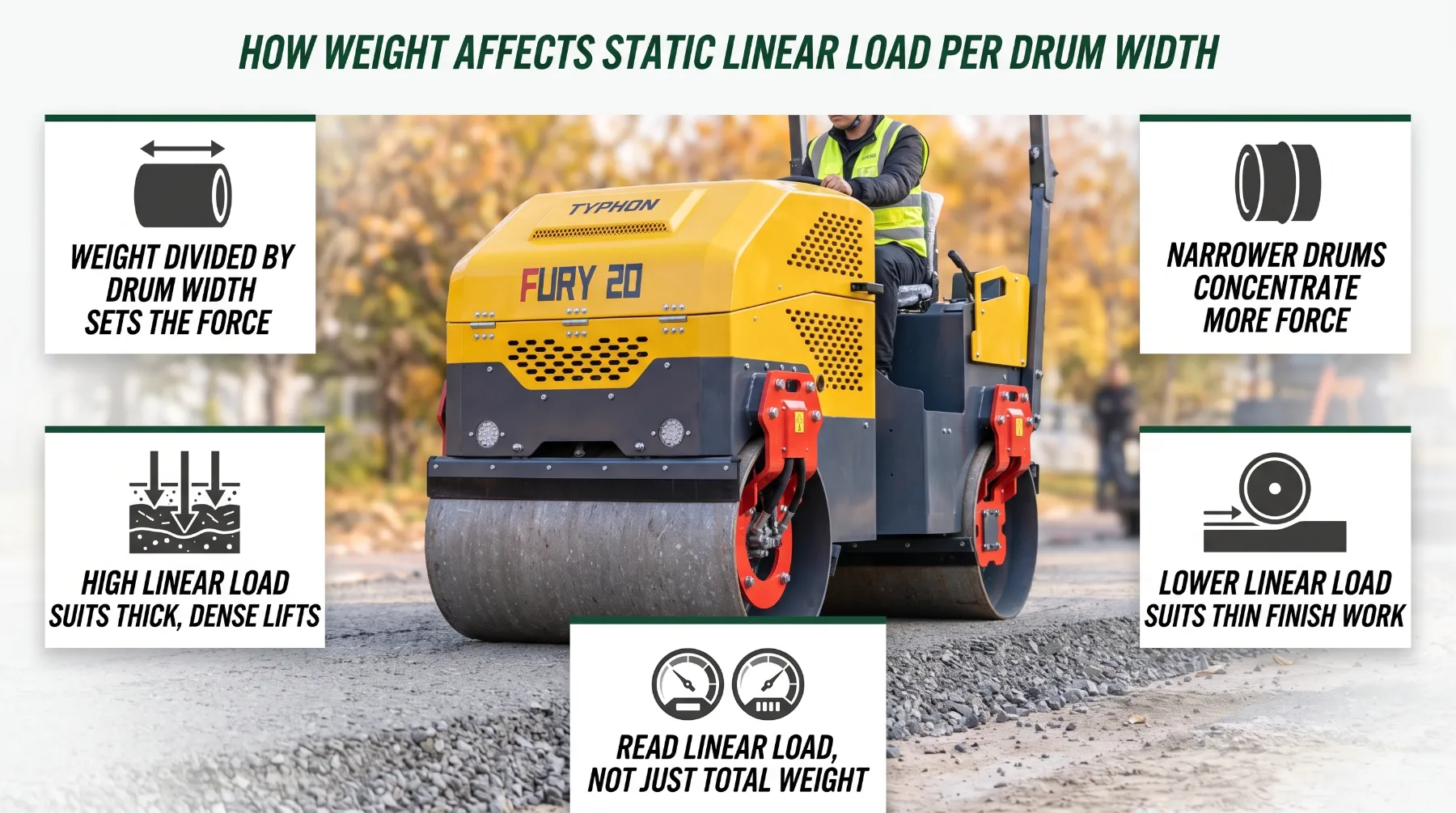
Raw weight tells only part of the story, because what the material actually feels is force concentrated along the width of the drum. Manufacturers express this as static linear load, the machine’s drum weight divided by the drum’s width, usually stated in kilograms or pounds per centimeter or inch. Two rollers of identical total weight can press very differently into the ground if one spreads its mass across a wider drum than the other. The narrower drum concentrates the same weight into a smaller footprint, driving a higher force per unit of width into the material.
This figure deserves more attention than total weight alone, because it predicts how hard the drum bites into a given lift. A high static linear load penetrates deeper and compacts denser material more effectively, which suits thick lifts and stubborn subgrade. A lower linear load spreads its effort more gently, better suited to thin layers and finishing work where aggressive penetration would mar the surface. When you compare rollers, reading the static linear load rather than the badge weight tells you how the machine will behave on your specific material, and it explains why a heavier machine on a wide drum can feel gentler than a lighter one on a narrow drum.
Key takeaway: What the material feels is weight concentrated along the drum’s width, so static linear load, not total weight alone, predicts how deeply and forcefully a roller compacts a given lift.
How Weight Interacts With the Vibration System
Most modern rollers combine static weight with a vibratory system, and the two forces work together rather than in isolation. Inside the drum, an eccentric shaft spins offset weights to shake the drum rapidly, and that oscillation adds dynamic force on top of the static load the machine already applies. The vibration loosens particles and lets them settle into a tighter arrangement, while the machine’s weight presses them home. Combined, static and dynamic force reach density far faster and deeper than either could alone, which is why vibratory rollers dominate serious compaction work.
Yet weight remains essential even on a vibrating machine, because the static mass anchors the drum and gives the vibration something to press against. A roller that is too light for its vibration output can begin to bounce, with the drum leaving the surface between strokes rather than driving energy consistently into the material. That bouncing wastes force, delivers uneven compaction, and can damage both the surface and the machine. Adequate weight keeps the drum in firm contact so the vibratory energy transfers cleanly into the lift on every stroke. The best results come when weight and vibration are engineered as a balanced pair, each sized to support the other rather than one overwhelming the machine’s ability to stay planted.
Key takeaway: Vibration adds dynamic force on top of static weight, but the machine’s mass anchors the drum so that energy transfers cleanly, making adequate weight essential for the vibration system to work as intended.
How Roller Weight Suits Different Materials and Lift Thicknesses
The material under the drum and the thickness of the layer being compacted decide how much weight the job truly demands, and matching the two is where good results begin. Loose granular fills, thick soil lifts, and dense subgrade resist compaction and reward a heavier machine that can drive force deep into the layer. On these materials, a light roller struggles to reach the lower portion of a thick lift, leaving it under-compacted beneath a firmer surface, a hidden weakness that undermines the finished structure. A heavier roller with strong static linear load carries the compaction energy all the way through, stabilizing the full depth of the lift.
Thin layers and delicate surfaces call for the opposite balance. Fresh asphalt wearing courses, thin overlays, and finishing passes need enough force to seat the material without crushing it, cracking the surface, or pushing it around under an overly aggressive drum. Here a lighter machine, or a heavier one used carefully with reduced or no vibration, protects the mat while still reaching target density. This is exactly why compaction fleets often run more than one weight class: a heavy machine for deep fills and subgrade, and a lighter one for surface courses and finishing. Choosing a single roller means honestly weighing which materials and lift thicknesses dominate your work, then selecting the weight that serves the majority of it well.
Key takeaway: Thick lifts and dense material demand a heavier machine to compact the full depth, while thin layers and finishing work call for a lighter touch, so weight must match the materials and lift thicknesses you handle most.
Practical Tips for Managing Roller Weight and Compaction
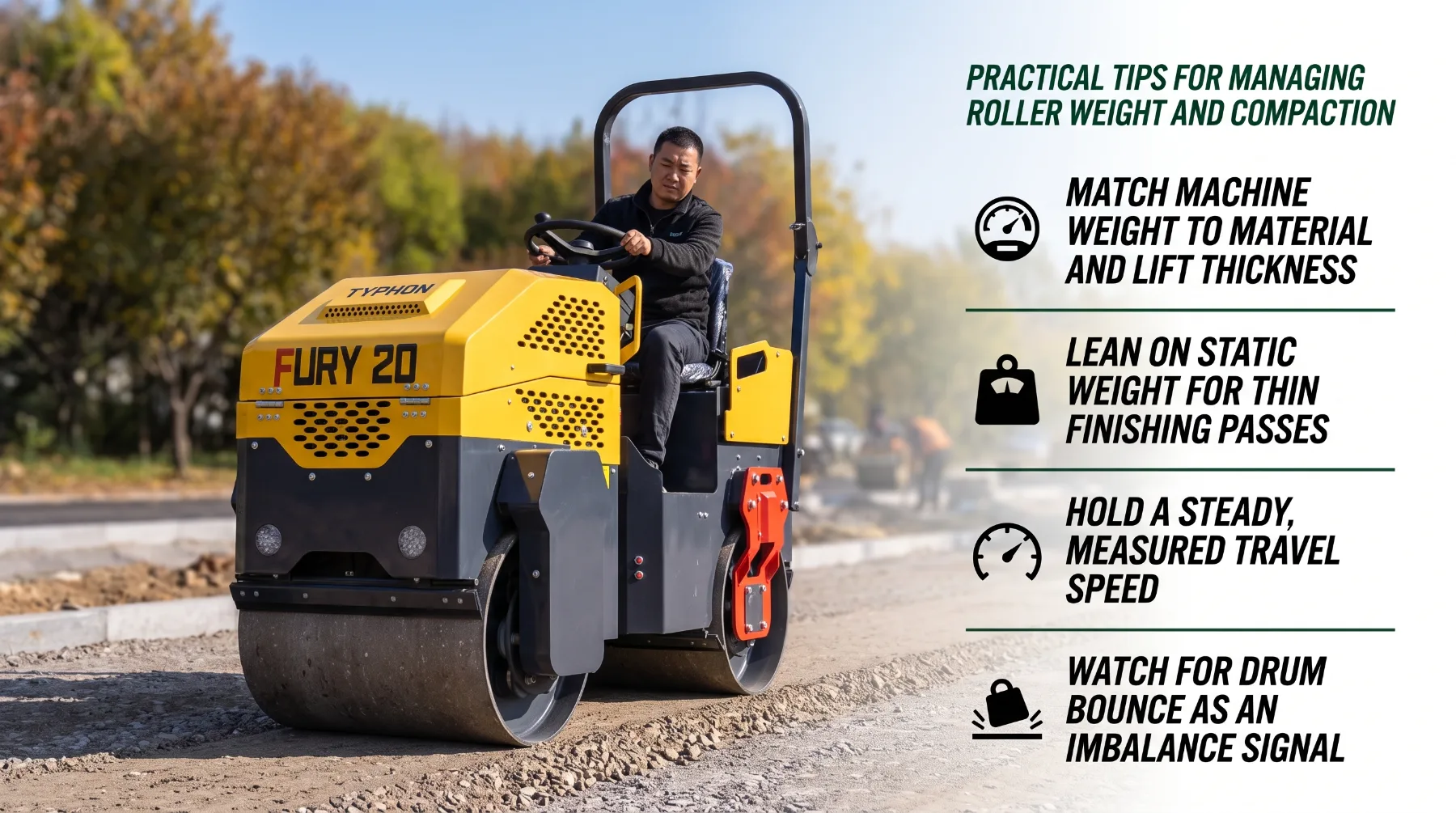
Getting the most from a roller’s weight comes down to matching the machine to the work and operating it with attention to how force reaches the material. Before a job begins, confirm that the machine’s weight and static linear load suit the material and lift thickness you plan to compact, and reserve your heaviest machines for the deep fills and dense subgrade that genuinely need them rather than sending them onto thin surface courses where they risk over-compacting. On thin lifts and finishing passes, lean on static weight and reduce or switch off vibration to protect the surface, letting the machine’s mass do the work without shaking the mat apart.
Operating technique matters as much as the specification. Hold a steady, measured travel speed so each pass delivers its full compaction energy rather than spreading force thinly over more ground, and plan your pass pattern deliberately so overlapping passes concentrate effort where density demands it instead of repeating sections needlessly. Watch the drum’s contact with the surface, since a drum that begins to bounce signals the weight and vibration are out of balance for that material, a cue to adjust amplitude or speed before compaction suffers. Keep the machine well maintained, because correct drum condition, sound ballast where fitted, and a healthy vibratory system all ensure the weight and force reach the material as designed. Taken together, these habits recover much of the density and efficiency that a mismatched or carelessly operated machine quietly forfeits.
Key takeaway: Match the machine’s weight to the material, lean on static force for thin lifts, hold steady speed with a planned pass pattern, and watch for drum bounce, so the roller’s weight reaches the material as intended on every pass.
Conclusion
Roller weight and compaction quality are closely linked, as machine mass provides the static force that presses material and helps the drum transfer vibration into the lift. Heavier rollers can reach deeper layers and reduce the number of passes needed, while lighter machines are better suited to thinner lifts and finishing work. Static linear load also shows how that weight is distributed across the drum width, making it an important factor alongside total weight and vibration performance. Match the roller to your material, lift thickness, site limits, and required density, then select a weight class that can deliver consistent compaction efficiently while keeping pass counts, fuel use, and machine wear under control.
Frequently Asked Questions
Does a heavier road roller always compact better?
Not necessarily. A heavier roller produces greater static force and static linear load, which helps on thick lifts, dense subgrade, and loose granular material that needs deeper compaction. However, excessive weight or aggressive vibration can damage thin asphalt layers, wearing courses, or finishing surfaces. Match the roller’s weight to the material and lift thickness rather than assuming the heaviest machine is always best.
What is static linear load, and why does it matter more than total weight?
Static linear load is the drum weight divided by drum width, usually expressed as force per unit of width. It shows how much force is concentrated along the contact area rather than simply measuring the machine’s total weight. Two rollers with the same operating weight can produce different compaction results if their drum widths differ. A higher static linear load generally provides stronger pressure for deeper or denser material, while a lower value offers gentler compaction for thinner lifts.
Why does the drum sometimes bounce, and how does weight relate to it?
Drum bounce occurs when the vibratory force is too strong for the roller’s weight or the material, causing the drum to lose consistent contact with the surface. This reduces energy transfer, creates uneven compaction, and can affect both the surface and machine. The roller’s static weight helps keep the drum planted so vibration transfers effectively into the material. If bouncing occurs, reduce amplitude, adjust travel speed, or check whether the roller’s weight and vibration settings suit the material.